Reviews Core Banking
SaaScada Review: Cloud-Native Core Banking Platform Features, Pricing Model and Enterprise Integration
At a glance
SaaScada delivers a cloud-native core banking system with no-code product configuration, real-time ledger processing, and multi-entity support for banks, neobanks, and BaaS providers.
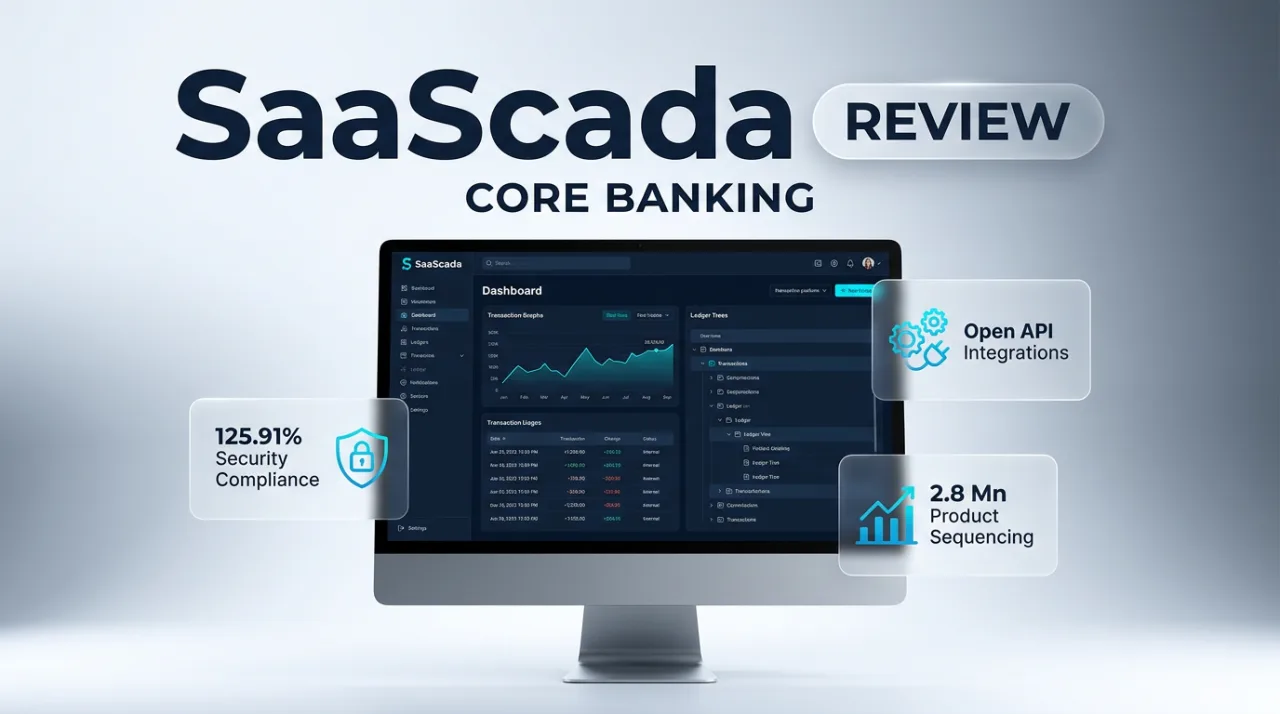
SaaScada Core Banking Platform Overview
SaaScada operates as a cloud-native core banking platform launched around 2016 to 2018 by a UK-based company with a Singapore entity. It targets banks, lenders, fintechs, neobanks, and banking-as-a-service providers that need real-time transaction handling without reliance on legacy modular systems. The platform supports unified processing for transactional banking, lending products including term loans, revolving credit, buy-now-pay-later, and mortgages, along with deposits, payments, and Islamic banking structures.
Recent adoption includes SME Bank in Lithuania, which completed migration of current accounts, payments, debit cards, and savings products in November 2026 after appointing a new CIO in September 2025. The move replaced a custom IT setup to support expansion into markets such as the Netherlands under Bank of Lithuania and ECB oversight. Earlier clients include Allica Bank in the UK, Relio in Switzerland, and NEXA in the UK, with operations spanning roughly ten countries.
The architecture relies on an event-sourced immutable ledger that records every transaction and permits full historical state reconstruction plus audit trails. CQRS and event-driven patterns enable concurrent high-throughput processing while feeding real-time data to risk, compliance, and analytics layers.
SaaScada Features, Pricing, and Security Details
Product Sequencer allows no-code configuration and versioning of banking products on a single ledger, eliminating separate modules for each product type. Open API-first design incorporates webhooks and event streaming for ecosystem connections. Multi-entity and multi-currency operations come with regulatory reporting tools and dedicated AWS environments that enforce data residency controls.

Pricing follows a quote-only model without published tiers or a free tier. Clients pay an upfront implementation fee that covers initial integrations plus a monthly SaaS fee calculated on the total number of accounts across all products. No separate charges apply for individual modules. A pay-by-the-hour prototyping environment exists for testing before full deployment.
Security measures include ISO/IEC 27001:2022 certification, SOC 2 Type II attestation covering security criteria from December 2025 through February 2026 with no exceptions noted, and GDPR compliance. Data protection uses AES-256 encryption at rest and TLS 1.2 or higher in transit, with all hosting on AWS infrastructure.
SaaScada Alternatives and Practical Limitations
Common alternatives include Mambu, Thought Machine Vault Core, 10x Banking, Tuum, Fiserv Finxact, Temenos Core, Oracle FLEXCUBE, and open-source options such as Mifos X or Apache Fineract. Mambu offers similar SaaS flexibility but often charges per module, while Thought Machine emphasizes vault-style ledger architecture with different integration patterns. 10x Banking focuses on greenfield deployments with its own configuration layer.
| Platform | Deployment Model | Configuration Approach | Pricing Transparency |
|---|---|---|---|
| SaaScada | AWS cloud-native | No-code sequencer | Quote only |
| Mambu | Cloud or hybrid | Configurable templates | Module-based |
| Thought Machine | Cloud | Vault ledger scripts | Enterprise quotes |
| 10x Banking | Cloud | Low-code platform | Custom |
Public user reviews remain limited, with most available commentary centered on the November 2026 SME Bank migration and its reported gains in product launch speed and regulatory reporting efficiency. No widespread complaints about outages or data issues appear in independent sources. Potential limitations include the absence of fixed public pricing, which complicates early budget planning, and reliance on dedicated AWS regions that may not suit every jurisdiction. Implementation timelines depend on the scope of integrations, and the platform has not published detailed roadmaps for upcoming AI or agentic features.
Frequently asked questions
What products does SaaScada support on a single ledger?
The platform handles transactional banking, multiple lending types including mortgages and BNPL, deposits, payments, and Islamic banking products through its unified event-sourced ledger.
How is SaaScada priced for new clients?
Pricing requires a custom quote and combines an upfront implementation fee with a monthly SaaS charge based on total accounts managed across all products.
Which compliance certifications does SaaScada hold?
It maintains ISO/IEC 27001:2022 certification, SOC 2 Type II attestation through February 2026, and GDPR alignment with AES-256 encryption and TLS 1.2 or higher on AWS.
How does SaaScada differ from legacy core systems?
It replaces siloed modules with a single no-code Product Sequencer, real-time event streaming, and concurrent transaction handling without separate code changes for each product.
Filed under
Comments 6