Reviews AI Models
Mistral Large 4 Review: Le Chonk 1T-Parameter MoE Model Capabilities and Open Weights
At a glance
Mistral Large 4 is a 1.05T-parameter MoE model with 1M context and open weights. This review details its API pricing, benchmarks, and deployment options.
Mistral Large 4, also called Le Chonk, is a 1.05-trillion-parameter mixture-of-experts model released in API preview on October 6, 2026, by Paris-based Mistral AI. The model supports text and image inputs with a 1-million-token context window and was trained on roughly 3,800 NVIDIA Grace Blackwell GPUs in European data centers. Open weights followed on October 29 under a modified MIT license that permits commercial model-as-a-service use only with an additional Mistral license.
Mistral Large 4 Architecture and Core Capabilities
The architecture uses 128 routed experts with four active plus one shared expert per token, resulting in 49–52 billion active parameters. A 1.6-billion-parameter vision encoder handles image inputs, while the text component covers more than 160 languages, including all official EU languages. Three reasoning modes—low, medium, and high—allow users to trade speed for depth, and the model includes native tool calling and structured output generation.
Independent evaluations place the preview version at 38.4 on the Artificial Analysis Intelligence Index, the highest score among non-Chinese open-weight models at launch. After weights release, the score dropped to 26 under high-reasoning settings, still leading non-Chinese open models by one point. On cybersecurity tasks the model reaches 82 percent on CyberGym-E2E reproduce-and-patch and 93 percent on Cybench. Coding performance shows 61.7 percent on DeepSWE v1.1 for the preview and 41 percent on Terminal-Bench 4.0 for the released weights.
Self-hosting requires substantial hardware. FP8 weights total 1.06 TB and NVFP4 weights 610 GB on Hugging Face. Official support exists for vLLM and SGLang, with recommended setups of eight H200 GPUs for FP8 or four Blackwell GPUs for NVFP4. Community GGUF quants allow inference on high-end single machines, such as 2-bit versions running at roughly 15 tokens per second on 512 GB Apple Silicon Ultra systems. Fine-tuning is possible through the TRL library.
Mistral Large 4 Pricing, Benchmarks, and Deployment Limits
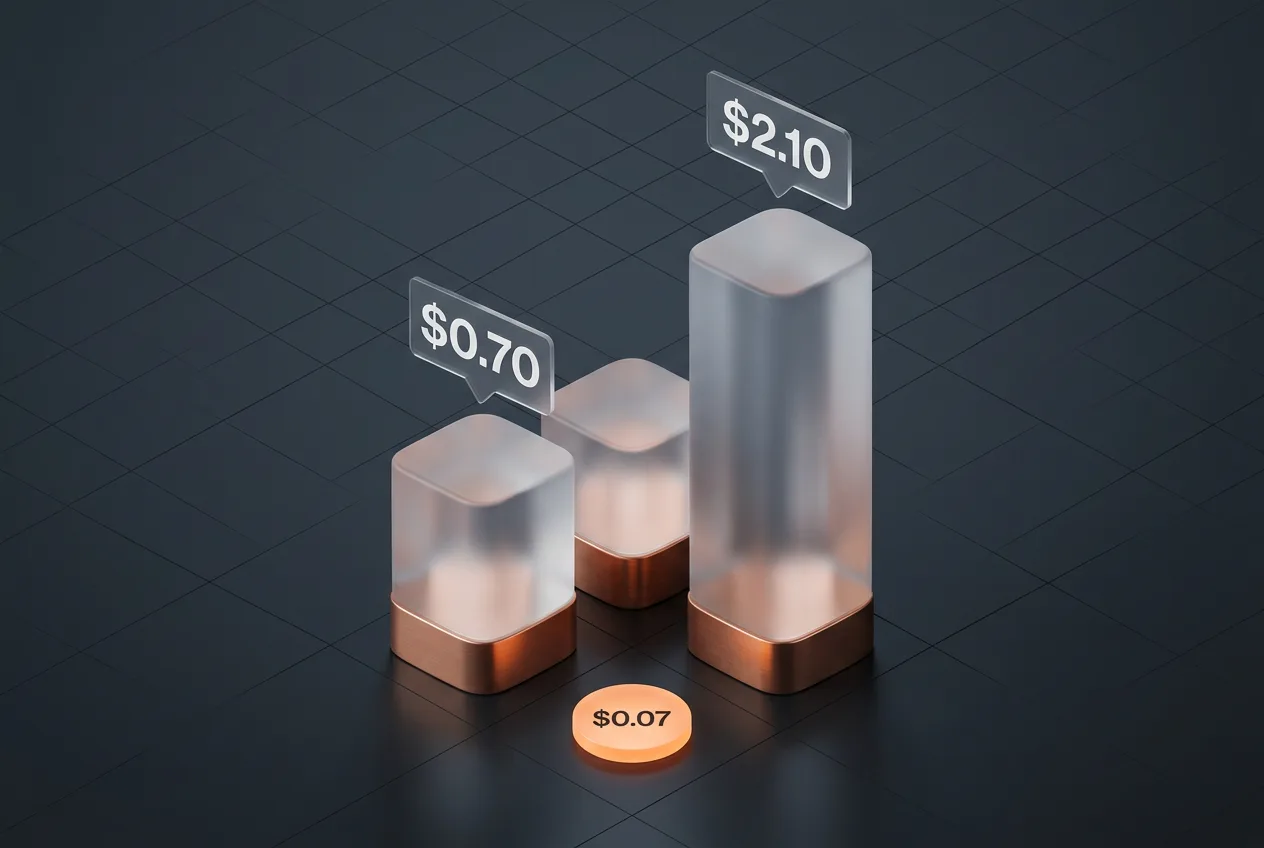
API pricing on Mistral’s platform stands at $0.70 per million input tokens, $0.07 for cached input, and $2.10 per million output tokens. Earlier preview rates were slightly lower at $0.68/$2.09. The model is accessible through Mistral API, OpenRouter, NVIDIA endpoints, and Microsoft Foundry.
| Model | Active Params | Context | Input $/M | Output $/M | Open Weights |
|---|---|---|---|---|---|
| Mistral Large 4 | 49–52B | 1M | 0.70 | 2.10 | Yes (Oct 2026) |
| GLM-5.3 | ~50B | 128K | 0.55 | 1.65 | Yes |
| Muse Spark Open | ~60B | 200K | 0.80 | 2.40 | Yes |
Human evaluations on Surge AI blind tests give the model 3.74 out of 5 for coding tasks, placing it second among five compared systems. Agentic performance on the Artificial Analysis Coding Agent Index reaches 48 percent while using approximately 47 percent fewer tokens than some competitors. General intelligence scores remain mid-pack relative to leading Chinese open models.
Limitations include higher hallucination rates on long-context multimodal tasks and reduced reliability in complex multi-step agent workflows compared with certain closed models. Full performance demands multi-GPU nodes or cloud rental; consumer hardware cannot deliver the intended speed or quality. No enterprise support packages or guaranteed uptime SLAs are published for self-hosted deployments.
Comparison with Alternatives and Practical Considerations
Against GLM-5.3 and Muse Spark Open, Mistral Large 4 offers the longest context and strongest reported cybersecurity metrics, yet trails on some general reasoning benchmarks. Its European training location and open weights support data-sovereignty requirements that closed U.S. models cannot meet. Organizations needing 1M-token contexts or native vision input gain concrete advantages, while teams focused on raw coding speed may find lower-cost alternatives sufficient.
Users should verify current benchmark versions before deployment, because scores shift with reasoning mode and evaluation updates. Fine-tuning on domain data can narrow gaps in agent reliability, but requires additional GPU hours and validation. The license permits commercial inference only through licensed Mistral endpoints or approved self-hosted arrangements.
Frequently asked questions
What is the context length of Mistral Large 4?
The model supports a native 1-million-token context window for both text and multimodal inputs.
How much do the Mistral Large 4 weights weigh?
FP8 checkpoints total approximately 1.06 TB while NVFP4 checkpoints are about 610 GB.
Can Mistral Large 4 run on a single consumer GPU?
No. Even quantized versions require high-end multi-GPU nodes or specialized hardware such as 512 GB Apple Silicon systems for acceptable speed.
Is Mistral Large 4 available through third-party platforms?
Yes. The model appears on OpenRouter, NVIDIA endpoints, and Microsoft Foundry in addition to the official Mistral API.
Filed under
Comments
No comments yet. Be the first!