Reviews Neocloud Platforms
General Compute Review: Inference-Focused Neocloud Platform, Chip Integrations and Funding Details
At a glance
General Compute operates an inference-focused neocloud that pairs ASICs with GPUs for low-latency AI workloads. The platform launched with substantial debt and equity backing in 2026.

General Compute review examines a San Francisco neocloud founded in 2025 that specializes in AI inference rather than training. The company buys specialized chips, places them in third-party colocation sites, and offers customers either bare-metal servers or token-per-second guarantees through a single contract and OpenAI-compatible endpoint. Its approach targets high-throughput tasks such as AI agents and coding assistants while claiming up to 16.2 times faster end-to-end performance than standard GPU clouds in internal benchmarks.
General Compute Funding and Capacity Timeline
The company raised a $15 million seed round in May 2026 at roughly $60 million valuation. In July 2026 it secured a debt facility of up to $400 million from Upper90 Capital Management, with the first $100 million tied to SambaNova hardware purchases. On October 27 2026 General Compute announced a $100 million Series A co-led by Blackbird Ventures and Abstract Ventures at an $800 million post-money valuation, bringing total disclosed equity and debt to approximately $515 million. An unnamed customer contract valued at more than $100 million in annual recurring revenue anchored the round.
Current operational capacity exceeds 30 MW with a pipeline above 50 MW. Management projects 75 MW deployed during 2027 and eventual access to roughly 200 MW of power. Major deployments of new hardware are scheduled for the first quarter of 2027, although smaller workloads already run for early customers at sites primarily in the United States.
Chip Portfolio, Architecture and Platform Limits
General Compute maintains a heterogeneous chip mix. It purchased SambaNova SN40 and SN50 dataflow ASICs through the debt facility and signed a multi-year agreement with Cerebras for wafer-scale CS-3 systems that will begin deployment in Q1 2027. Additional planned hardware includes Positron AI systems in the same quarter and AMD MI300X GPUs for prefill stages. The platform emphasizes air-cooled ASICs to simplify placement in repurposed Bitcoin-mining facilities and other colocation spaces.
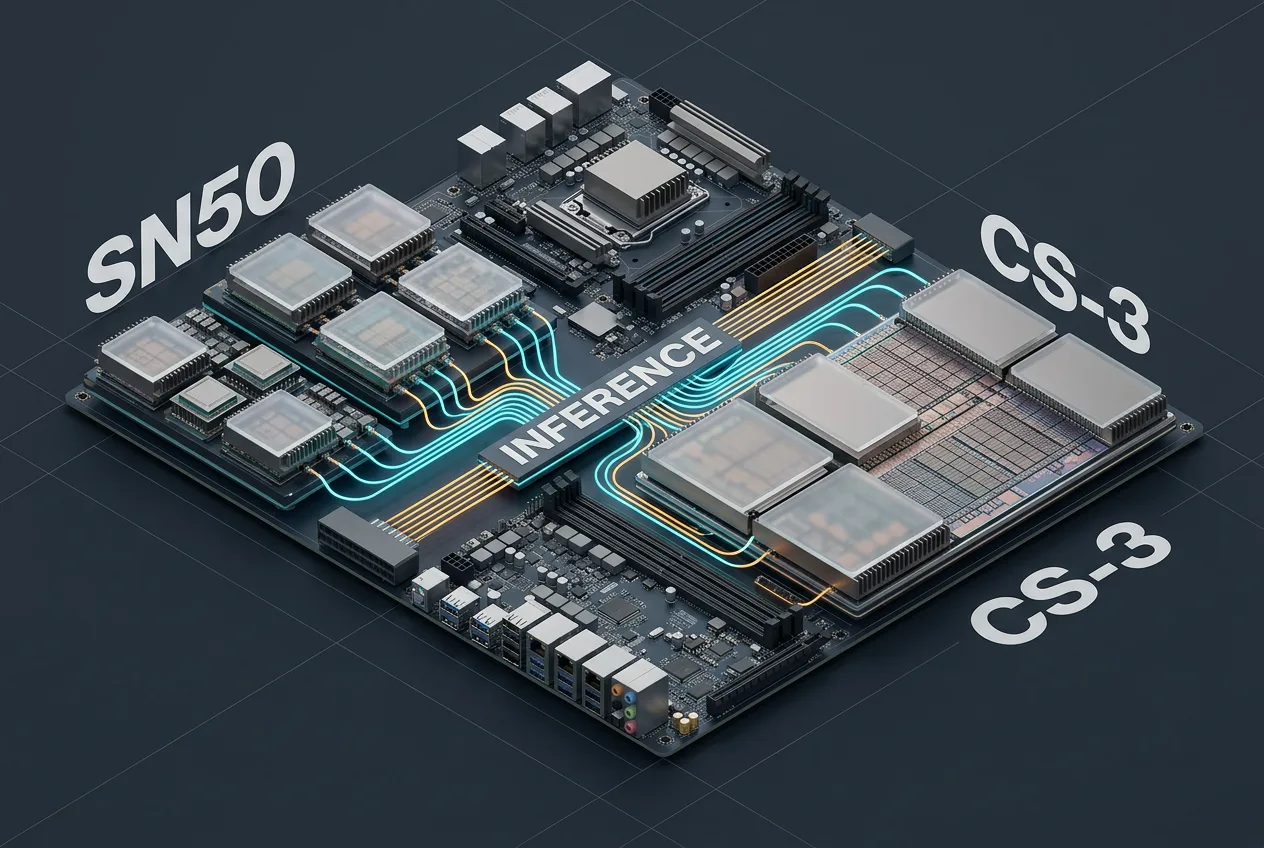
Customers receive dedicated hardware or TPS SLAs under one contract. The architecture separates prefill on GPUs from decode on ASICs and supports models from major labs plus open-source options. No public pricing tiers or per-token rates appear on the company site; billing details remain available only after direct inquiry.
General Compute positions itself against GPU-heavy neocloud providers amid sector concerns about consolidation. Its benchmarks focus on end-to-end latency and throughput for inference workloads, yet independent third-party verification of the 16.2 times claim has not been published. Power procurement, site leasing and continued hardware financing remain stated priorities for the company through 2027.
Frequently asked questions
When did General Compute raise its Series A?
General Compute announced its $100 million Series A on October 27 2026 at an $800 million post-money valuation.
Which chips does General Compute use?
The platform integrates SambaNova SN40 and SN50 ASICs, Cerebras CS-3 wafer-scale systems, Positron AI hardware, and AMD MI300X GPUs.
Is General Compute pricing public?
No detailed public pricing or per-token rates are listed; contract terms appear available only through direct sales contact.
What capacity does General Compute target for 2027?
The company expects to reach 75 MW of deployed capacity in 2027 while pursuing access to approximately 200 MW of power.
Filed under
Comments
No comments yet. Be the first!