Reviews AI Models
Kimi K3.1 Pro Review: 2.8T MoE Model Features, 1M Context Pricing and API Access
At a glance
Kimi K3.1 Pro is a 2.8T MoE model from Moonshot AI with a 1M context window, multimodal input, and OpenAI-compatible API released in October 2026.
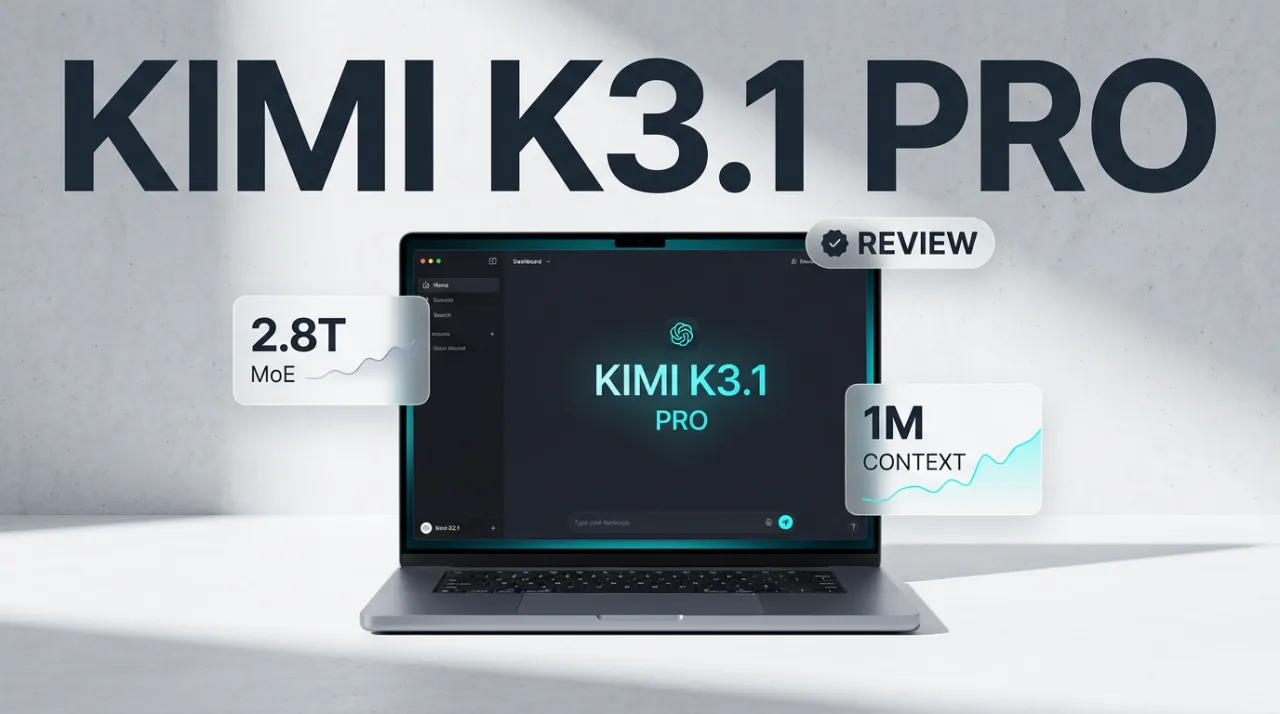
Kimi K3.1 Pro is a post-trained mixture-of-experts model developed by Moonshot AI. It totals 2.8 trillion parameters with 104 billion active parameters per token and supports a native 1,048,576-token context window. The model handles text and image inputs directly, with video supported through the API, and targets coding, agentic workflows, and domain-specific reasoning tasks.
Overview and Key Features
Moonshot AI released Kimi K3.1 Pro on October 23, 2026, alongside access through Kimi.ai, Kimi Work, and Kimi Code applications. The open weights appeared on Hugging Face under the repository moonshotai/Kimi-K3.1-Pro on November 4, 2026, under a custom MIT-style license that requires separate agreements for MaaS providers exceeding 20 million dollars in annual revenue. The model builds on the July 2026 Kimi K3 release through large-scale joint reinforcement learning across coding, 3D/CAD, finance, and agent domains.
Technical specifications include 93 layers, 896 experts with 16 routed and 2 shared experts per token, and hybrid attention using 69 KDA layers plus 24 Gated DSA layers. A MoonViT-V2 401M vision encoder processes images, and weights use MXFP4 quantization-aware training. Users can select reasoning effort levels of low, high, or max, with max as the default. The API remains fully OpenAI-compatible, allowing direct substitution in existing codebases without major rewrites.
Performance figures reported by Moonshot at maximum effort include 65.7 percent on Terminal-Bench 4.0, 51.7 percent on SWE-Marathon v1.1, 92.1 percent on BrowseComp, 70.0 percent on HLE-Full with tools, 94.2 percent on GPQA-Diamond, and 92.7 percent on BenchCAD with tools. Independent evaluations placed the model at an Artificial Analysis Intelligence Index of approximately 55 at launch, ranking fourth overall behind leading closed models. Results on science and terminal subtasks were lower, with Terminal-Bench Science near 38 percent.
Pricing, Access Options and Comparisons
Moonshot charges 2 dollars per million input tokens and 10 dollars per million output tokens on the standard pay-as-you-go API. Cached input costs 0.20 dollars per million tokens, while cache writes cost 2 dollars for a five-minute TTL or 4 dollars for a one-hour TTL. A high-speed variant doubles these rates to 4 dollars input and 20 dollars output. The minimum top-up to activate access is 1 dollar. These rates are lower than the prior Kimi K3 model at 3 dollars input and 15 dollars output.

Official access runs through platform.kimi.ai or api.moonshot.ai. Third-party hosts such as Featherless initially offered 256K context. Self-hosting requires multi-GPU setups, for example eight AMD MI355X cards or NVIDIA Blackwell nodes, and works with vLLM, SGLang, or ATOM frameworks that include day-zero optimizations. Single-GPU inference is not practical given model size.
| Model | Input Price per M Tokens | Output Price per M Tokens | Context Window | Open Weights |
|---|---|---|---|---|
| Kimi K3.1 Pro | $2 | $10 | 1M | Yes (custom license) |
| Claude Opus 5.5 | $15 | $75 | 200K | No |
| GPT-6 Astra | $10 | $30 | 128K | No |
Public user feedback remains limited because the open weights have been available for only ten days as of November 14, 2026. Early reports on developer forums note strong coding performance in agent loops and improved hallucination control compared with the July K3 release, while some users cite higher memory requirements during local inference than expected from the active parameter count. No widespread complaints about API uptime or billing accuracy have surfaced yet.
Limitations and Final Assessment
The model shows weaker results on pure science and terminal benchmarks relative to its coding and browsing scores. Cyber-related training data was filtered before the open release, which reduced an internal exploit benchmark from 90.5 percent to 81.0 percent. Self-hosting demands substantial hardware, and third-party hosted options currently cap context below the full 1M tokens. The custom license adds friction for large commercial MaaS providers.
Kimi K3.1 Pro delivers competitive agentic and coding benchmarks at lower API prices than comparable closed models while offering open weights under a permissive but not fully unrestricted license. Its 1M context and multimodal support provide clear technical advantages for long-document and multi-turn agent workflows, though hardware demands and early-stage third-party hosting limit immediate accessibility for smaller teams.
Frequently asked questions
What is the context window size of Kimi K3.1 Pro?
The model supports a native context window of 1,048,576 tokens, equivalent to one million tokens.
How much does the Kimi K3.1 Pro API cost?
Standard pricing is 2 dollars per million input tokens and 10 dollars per million output tokens, with cached input at 0.20 dollars per million.
When were the open weights for Kimi K3.1 Pro released?
Moonshot AI published the weights on Hugging Face on November 4, 2026, eleven days after the initial API launch.
Can Kimi K3.1 Pro run on a single GPU?
No. Self-hosting requires multi-GPU configurations such as eight AMD MI355X or equivalent NVIDIA Blackwell nodes.
Is Kimi K3.1 Pro OpenAI API compatible?
Yes. The API endpoint follows the OpenAI specification, allowing direct integration with existing client libraries.
Filed under
Comments
No comments yet. Be the first!