Reviews Cisco
Cisco AI Agent Security Review: Zero Trust Controls for Agentic AI
At a glance
Cisco extends its Zero Trust platform to AI agents with identity management, fine-grained access controls and real-time runtime guardrails against prompt injection and data exfiltration.
Cisco AI Agent Security Stack applies the company's existing Zero Trust framework to autonomous AI agents through Duo Agentic Identity, Secure Access gateways and AI Defense runtime monitoring. The stack addresses risks that arise when agents operate across tools and APIs at machine speed, including over-privileged access, prompt injection and memory poisoning. Major updates rolled out in March 2026 at RSAC, with further MCP gateway and red-teaming features added through November.
Cisco AI Agent Security Review: Identity Controls and Access Policies
Identity management begins with Duo Agentic Identity, which registers agents as non-human identities and maps them to human owners. The system discovers shadow agents through network and platform visibility, then supports full lifecycle operations from onboarding to offboarding. OAuth 2.1 and OIDC standards are used alongside MCP integration so agents receive just-in-time credentials instead of long-lived secrets.
Access policies move beyond session-based rules to per-action, intent-based enforcement. The MCP Gateway intercepts tool calls and authorizes only the specific action requested, limiting exposure of backend services and APIs. Policies can be time-bound and tied to least-privilege principles, reducing the blast radius if an agent is compromised or behaves unexpectedly.
These controls integrate directly into Cisco's SASE and Zero Trust fabric, eliminating the need for a separate overlay. Enterprises gain a single inventory that treats agents alongside human users, satisfying governance requirements that currently keep most organizations from scaling agent deployments beyond pilot stages.
Runtime Protections, Deployment and Comparison with Alternatives
AI Defense supplies bidirectional guardrails that inspect prompts, responses and MCP traffic in real time. Detection covers prompt injection, sensitive data leakage, toxicity, code generation attempts, tool exploitation and privilege escalation. Policy Studio allows customization, while Talos threat intelligence supplies updated detection signatures. An SDK enables one-line integration for developers, and support extends to hybrid, cloud and on-premises environments including NVIDIA platforms.
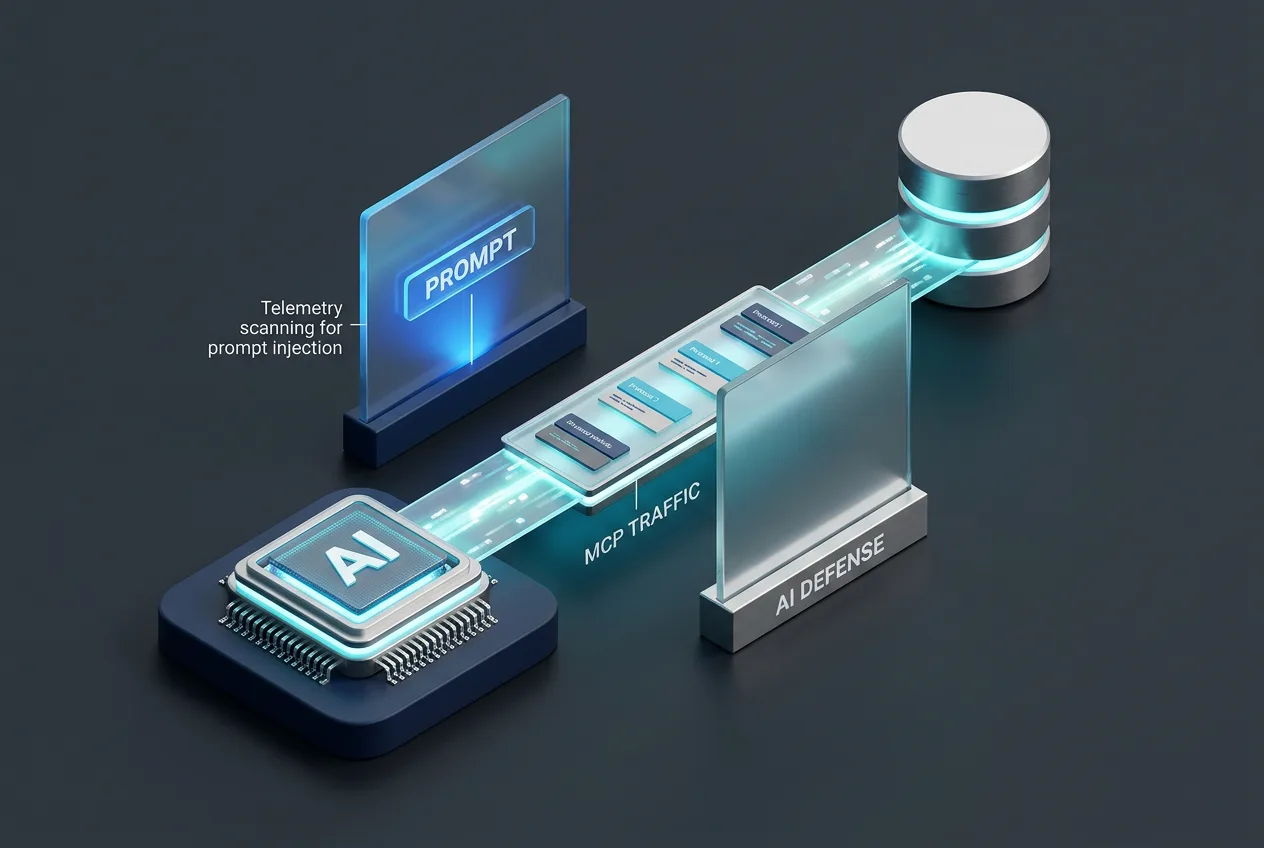
Additional capabilities include AI supply-chain scanning for MCP servers and models plus algorithmic red teaming that applies more than 200 attack techniques in single-turn and multi-turn scenarios. Red-teaming results feed back into the continuous trust loop of test, observe and govern. Explorer Edition is available for self-service testing, while full features require the broader Cisco platform subscription.
Compared with standalone agent security offerings, Cisco's approach reuses existing Duo and Secure Access infrastructure rather than requiring new consoles. This reduces operational overhead but ties users more closely to the Cisco ecosystem. Organizations already running Cisco SASE see faster rollout; those using competing SASE or IAM stacks face additional integration work. Pricing follows standard Cisco enterprise licensing with no public per-agent rates published, and hidden costs may appear in the form of additional Duo or Splunk seats for observability.
Limitations include the current scope of red-teaming targets, which remains restricted to registered endpoints, and the absence of broad third-party benchmark data on false-positive rates in production agent workloads. User reports on public forums note solid visibility into agent activity yet mention occasional policy tuning required to avoid blocking legitimate tool calls. No major breaches tied to the stack have been disclosed, though the product itself is still early in its deployment lifecycle.
Frequently asked questions
What identity standards does Cisco use for AI agents?
Duo Agentic Identity supports OAuth 2.1 and OIDC, registers agents as non-human identities, and maps each agent to a human owner for accountability.
How does the MCP Gateway limit agent access?
It intercepts individual tool calls, issues just-in-time credentials, and enforces per-action policies instead of granting broad session rights to backend APIs.
Is pricing information available for the Cisco AI Agent Security Stack?
Cisco has not published per-agent rates. Full features require enterprise platform licensing, and additional Duo or Splunk seats may increase total cost.
What runtime threats does AI Defense address?
The system detects prompt injection, data leakage, toxicity, tool exploitation, privilege escalation and memory poisoning through real-time inspection of prompts and MCP traffic.
Filed under
Comments 6