Reviews AI Models
Gemini Decision 1 Review: Multimodal Decision API Capabilities and Pricing
At a glance
Gemini Decision 1 provides a specialized multimodal decision model that scores up to 1,000 questions against shared inputs in one pass, with pricing starting at $0.10 per million tokens.
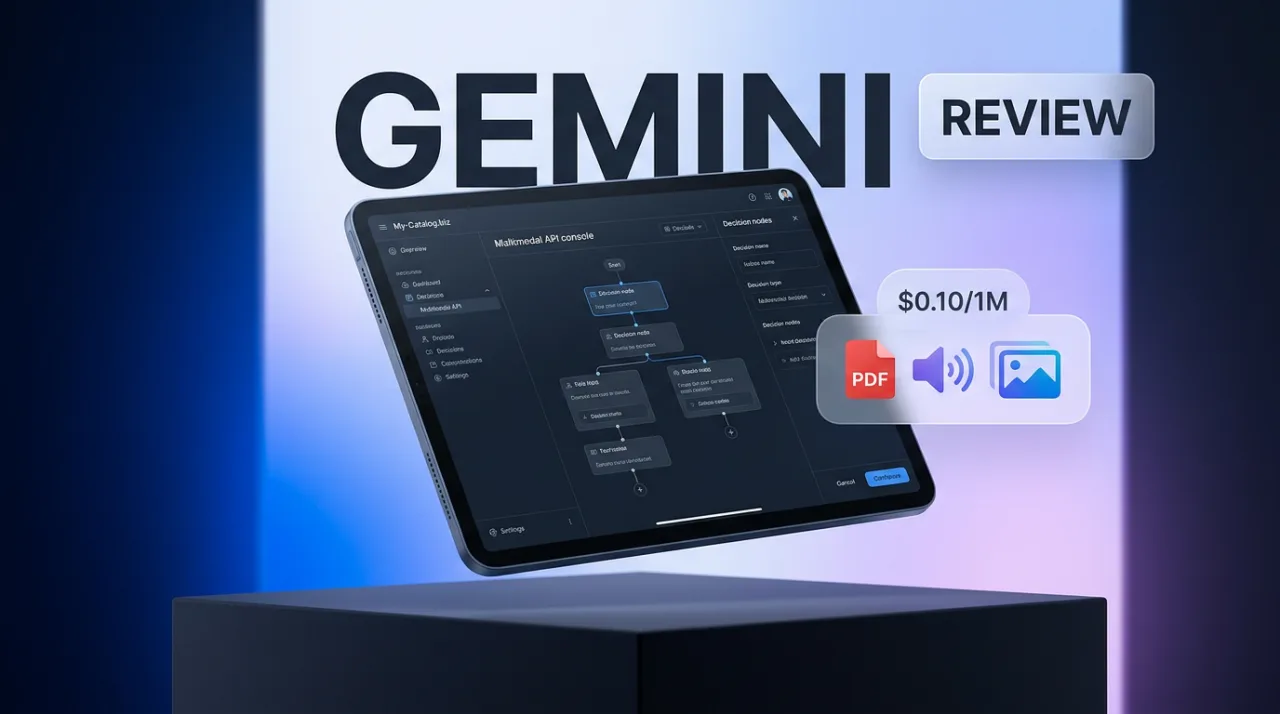
Gemini Decision 1 launched on November 11, 2026, through Google AI Studio and the Gemini Developer API. The model handles multimodal inputs and returns calibrated probabilities for closed-set questions without generating output tokens. It targets tasks such as routing, policy checks, and rubric scoring rather than open-ended text production.
Gemini Decision 1 Review: Core API Capabilities
The API accepts text, images, audio, video, and PDFs in a single shared input up to 262,144 tokens. Inline base64 files reach 100 MB, while external URLs are limited to 15 MB. Questions support yes/no answers, single-select choices from 2 to 255 options, or ordered rubric scores, with up to 1,000 independent queries evaluated in one forward pass. Results include probabilities between 0.01 and 0.99 for yes/no items plus per-answer confidence scores from 0 to 1.
End-to-end latency stays between 150 and 250 milliseconds, with model compute at 50 to 100 milliseconds for contexts of 16,000 tokens or less. Latency holds steady as question counts rise from one to over 100. The service runs on the v1beta endpoint via the google-genai SDK or REST calls, and a Decisions Playground exists inside Google AI Studio. Vertex AI integration remains listed as coming soon, with no open weights or self-hosting options available.
Google reports top-1 accuracy leading seven of nine benchmarks against comparators including Jev 1.14 and GPT-6 Luna. Scores include 92.2 percent on JevBench, 79.8 percent on PubMedQA, and 71.8 percent on MMAU audio tasks, alongside the lowest calibration error of 0.0250 Top-1 ECE. Internal uses at Google include dynamic routing in Gemini Notebook and safety filters in Search.
Pricing, Rate Limits, and Benchmark Comparisons
Paid pricing charges $0.10 per million input tokens across all modalities, with zero cost for output tokens. The shared input counts once per request regardless of question volume. A free tier in Google AI Studio supports prototyping but notes that data may be used for product improvement. No context caching, Batch API, or priority tiers exist at launch.

Free tier rate limits allow 200 requests per minute, 50,000 tokens per minute, and 10,000 requests per day. Paid Tier 1 raises these to 1,500 requests and 1 million tokens per minute, with limits applied per project. Safety filters remain active, and high-stakes applications require human oversight according to Google documentation.
| Model | Input Price per 1M Tokens | Questions per Call | Multimodal Support | Output Tokens Billed |
|---|---|---|---|---|
| Gemini Decision 1 | $0.10 | Up to 1,000 | Text, image, audio, video, PDF | $0 |
| GPT-6 Luna | $0.15 | Variable | Text, image | Standard rate |
| Jev 1.14 | $0.12 | Single or small batches | Text, image | Standard rate |
Independent indices place Gemini Decision 1 around the middle of decision-model rankings, with an Artificial Analysis Decision Index near 66. The model does not support open-ended generation or multi-step reasoning, directing those tasks to the separate Interactions API.
Access Options and Documented Limitations
Developers access the service through the client.decisions.create method or direct REST calls. OpenRouter also lists the model. Free tier users face daily request caps, while paid accounts scale with project limits and no separate OCR or transcription fees apply. Google self-reports all benchmark numbers, and independent verification remains limited at this early stage.
Common user feedback on developer forums notes strong calibration on safety and routing tasks but occasional prompt sensitivity when question sets exceed 500 items. No major outages have been reported since the November 11 launch. The absence of Vertex AI support and context caching currently restricts enterprise-scale deployments compared with established generative models.
Frequently asked questions
What input types does Gemini Decision 1 accept?
The model processes text, images, audio, video, and PDFs natively in one shared input. Limits reach 262,144 tokens total, with inline files up to 100 MB and external URLs up to 15 MB.
How much does Gemini Decision 1 cost per million tokens?
Paid usage costs $0.10 per million input tokens with no charge for output tokens. The shared input is billed once per request, and a free tier exists for prototyping in Google AI Studio.
What rate limits apply to the free tier?
Free tier users receive 200 requests per minute, 50,000 tokens per minute, and 10,000 requests per day. Paid tiers increase these limits, such as Tier 1 at 1,500 requests and 1 million tokens per minute.
Does Gemini Decision 1 generate text output?
No. The model returns only probabilities and confidence scores for closed-set questions. It does not produce generative text and bills zero output tokens.
Filed under
Comments 1