Reviews LLM Review
Inception Mercury 3 Review: Diffusion LLM Speed, Pricing and Use Cases
At a glance
Inception Mercury 3 delivers 1,068 tokens per second through its diffusion architecture, with a 1M-token context and API pricing starting at $0.10 per million input tokens after launch discount.

Inception Mercury 3 reached general availability on October 19, 2026, as the latest diffusion-based LLM from Inception Labs. The model produces text by refining blocks of tokens in parallel instead of generating them sequentially. This approach yields reported output speeds of 1,068 tokens per second on NVIDIA GPUs while maintaining a 1-million-token context window.
Inception Mercury 3 Overview and Key Capabilities
The model supports tool calling, structured outputs, and adjustable reasoning effort levels labeled instant, low, medium, and high. Maximum output length reaches approximately 131,000 tokens. Parameter count grew more than 40 times compared with Mercury 1, and the company reports roughly three times higher scores on standard benchmarks than the prior version. An OpenAI-compatible API endpoint allows integration through Inception Labs, OpenRouter, Baseten, and Vercel.
Early partner deployments highlight latency-sensitive applications. TinyFish reported 50 percent success on 50 Mind2Web browser tasks at costs comparable to GPT-6.1-Sol. RevisionDojo measured roughly one-second feedback loops in tutoring scenarios. Octen recorded median generation times of 0.9 seconds for smart-glasses search queries. These cases show the speed advantage compounds in agent, voice, and real-time search workloads.
Pricing, Benchmarks, and Practical Limitations
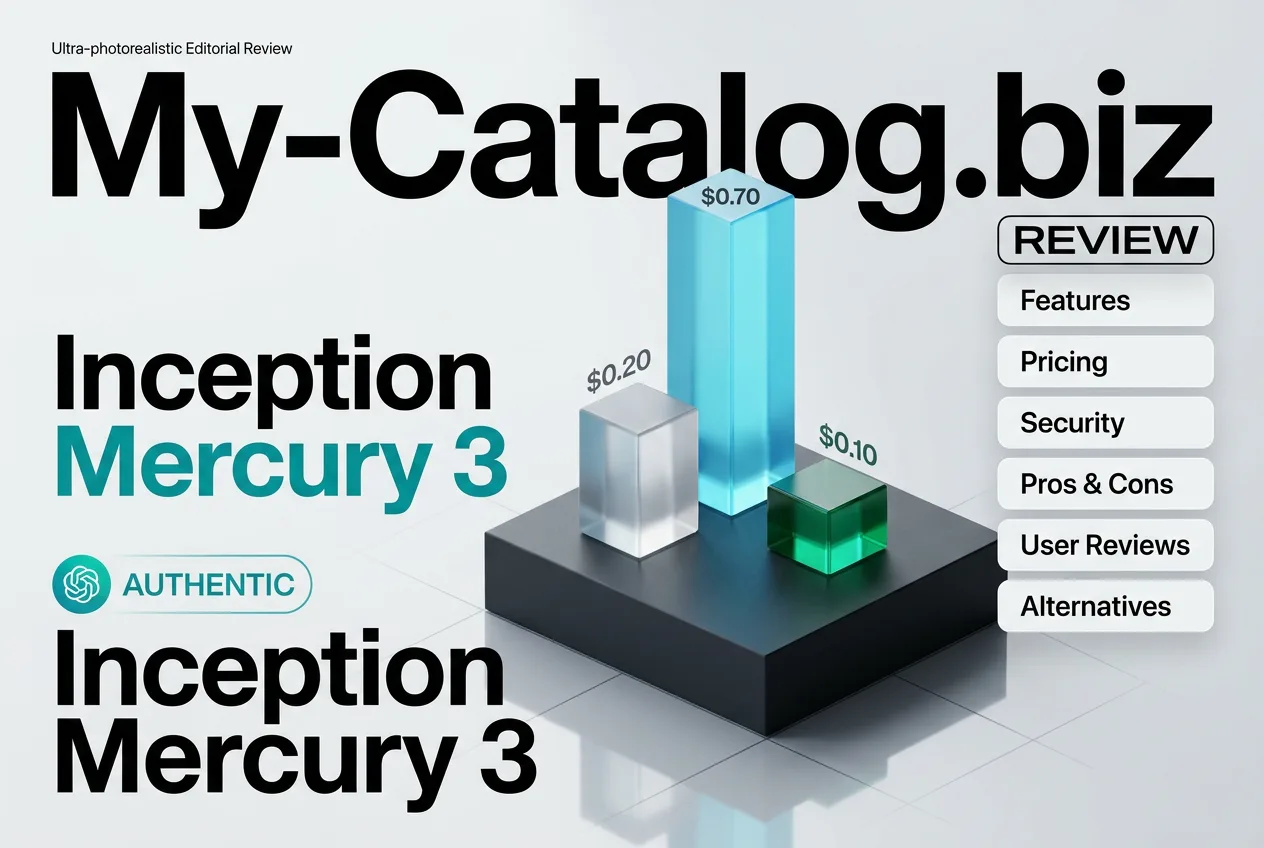
Standard API rates list at $0.20 per million input tokens and $0.70 per million output tokens. A launch promotion halves those figures to $0.10 input and $0.35 output. Cached input tokens receive an additional 90 percent discount to $0.01. New accounts receive 100 million free tokens upon signup. No duration for the promotional rates has been announced.
Independent test suites on OpenRouter show strong performance on short reasoning and coding tasks, with one 306-test run reaching 93 percent accuracy at roughly half the median time of comparable models. Long-context results remain mixed in vendor data, with trailing scores on MRCR v2 and AA-LCR. Production variability appears on complex multi-step creative tasks.
| Metric | Mercury 3 (medium) | GPT-6 Luna | Claude Haiku 5.5 |
|---|---|---|---|
| IFBench | 76.84 | 61.82 | 54.65 |
| SWE-Bench Atlas | 51.08 | 33.33 | 32.26 |
| GPQA Diamond | 89.23 | 86.36 | 84.51 |
Reported limitations include reduced gains when heavy reasoning levels are enabled and inconsistent results on extended creative or long-horizon planning. No independent security audits or data-handling certifications have been published yet. Early user reports note occasional quality drops on tasks exceeding several thousand tokens.
Direct comparisons place Mercury 3 ahead on eight of twelve vendor benchmarks against GPT-6 Luna and Claude Haiku 5.5, though trailing on certain long-context evaluations. Speed remains the clearest differentiator for workloads where per-step latency matters more than peak benchmark scores.
Frequently asked questions
What is the current pricing for Inception Mercury 3 API calls?
List rates are $0.20 per million input tokens and $0.70 per million output tokens. A launch discount reduces these to $0.10 and $0.35 respectively, with cached input at $0.01.
How fast does Mercury 3 generate tokens?
Official tests report 1,068 tokens per second on NVIDIA GPUs. Real-world OpenRouter runs confirm the speed advantage on short and medium-length reasoning tasks.
Does Mercury 3 support long context windows?
The model accepts up to 1 million tokens in context, an increase from 260,000 tokens in Mercury 2.5. Performance on very long contexts shows mixed results in published benchmarks.
Where can developers access the Mercury 3 API?
The model is available through the official Inception Labs endpoint as well as OpenRouter, Baseten, and Vercel platforms.
Filed under
Comments
No comments yet. Be the first!