Reviews Vultr
Vultr Enterprise IAM and VX1 Review: Agentic AI Upgrades, Clusters and Storage Features
At a glance
Vultr added enterprise IAM tools, VX1 cloud compute plans, and cluster improvements in 2026 to support secure, scalable agentic AI deployments.
Vultr released platform updates in October 2026 that expand identity controls and compute options for organizations running agentic AI systems. The changes include refined IAM features first introduced in April 2026, the VX1 line of AMD EPYC instances launched in late 2025, and storage options that allow boot volumes to persist after instance deletion.
These additions target multi-tenant environments where agents and human users require separate access boundaries. Organizations gain tools to enforce least-privilege rules while provisioning clusters that combine CPU and GPU nodes without manual network configuration.
Vultr Enterprise IAM, VX1 Instances, and Cluster Capabilities
The October 2026 IAM release introduces Vultr as an OAuth provider, SCIM provisioning from external directories, and audit logs that record both user and agent actions. Fine-grained policies operate at the service, action, and resource level, with organizations serving as isolated top-level containers. Roles, groups, and service accounts support role assumption and API key management, while legacy ACLs convert automatically during migration. Limits stand at approximately 100 policies, roles, or groups per organization, and OIDC plus role trusts remain available.
VX1 instances, based on AMD EPYC processors, range from 2 to 192 vCPUs and target web servers, databases, microservices, and the CPU layer of agentic AI stacks. Reported metrics include up to 82 percent better performance per dollar and 33 percent lower cost per vCPU compared with certain hyperscaler efficiency plans, along with 48 percent lower power draw per vCPU. Networking reaches 50 Gbps, CPUs are dedicated, and boot volumes can use either local NVMe or encrypted Vultr Block Storage with AES-256. Instant provisioning is supported in initial regions including New Jersey and Atlanta.
Clusters now allow self-service creation of multinode groups that mix CPU, GPU, and bare-metal instances with automated RoCE or InfiniBand networking. Supported schedulers include Slurm and Kubernetes. A refreshed console interface simplifies head-node setup and scaling to reduce idle capacity. Earlier April 2026 changes added CPU node support and head-node options.
Storage Updates, Security Controls, and Practical Constraints
Bootable Block Storage volumes now survive instance deprovisioning on both VX1 and Cloud GPU instances, enabling cloning and replication from validated images while local NVMe continues to serve scratch workloads. The feature accelerates repeated deployment of CPU-plus-GPU configurations for training and inference pipelines.
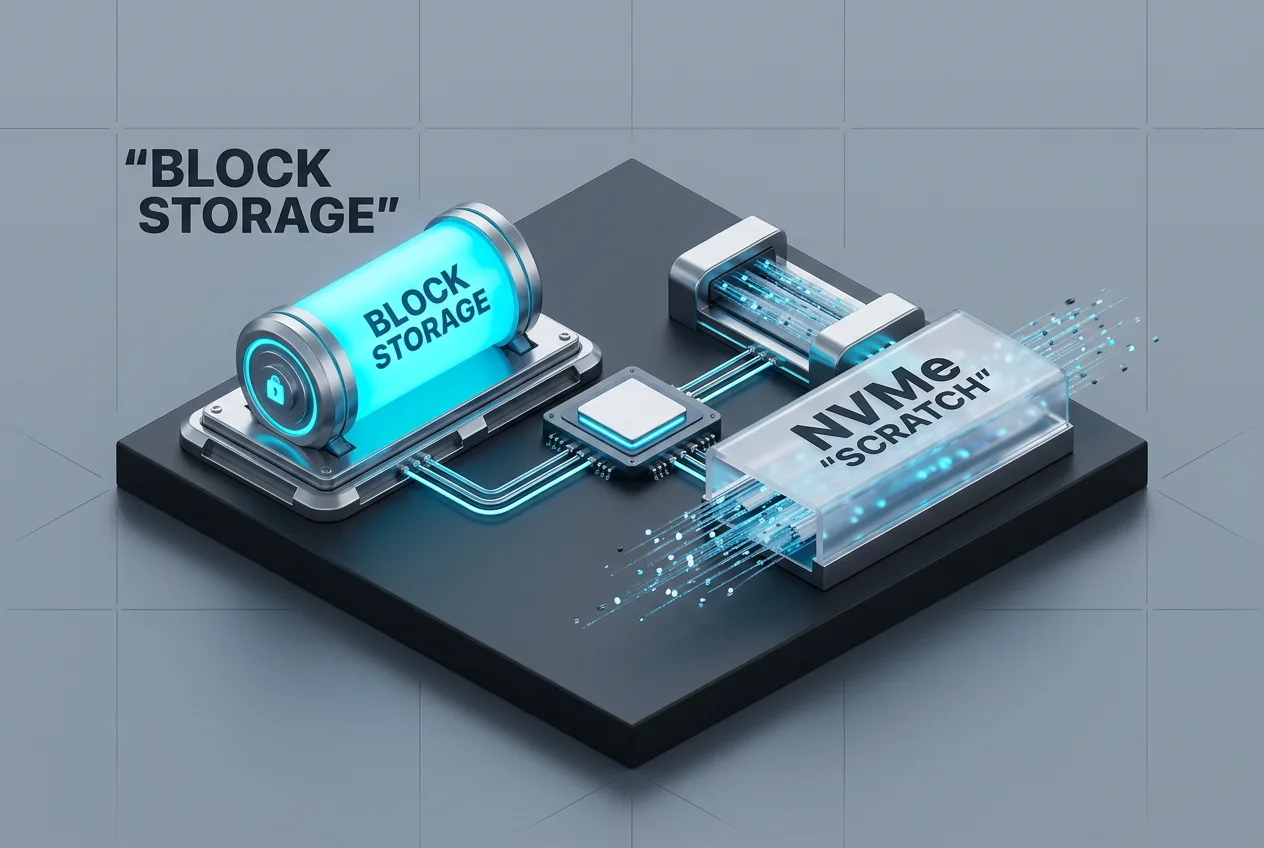
Security elements center on the new IAM boundaries, audit logging for compliance, and data-sovereignty choices across Vultr’s 33-plus global regions. No public details on independent security certifications or third-party audits appear in the October announcements. Planned capacity includes a 20 MW Chennai facility using AMD Instinct MI355X GPUs, though commissioning dates and exact GPU counts remain unconfirmed.
Current limits include the 100-policy ceiling per organization and the phased regional availability of VX1 instances. Cluster networking and the new console interface are still rolling out, so users may encounter temporary differences between documented and live behavior. No public pricing tables list exact hourly or monthly rates for VX1 tiers or cluster head nodes.
| Feature | VX1 Cloud Compute | Cluster Support | Block Storage Boot |
|---|---|---|---|
| Instance Types | 2–192 vCPUs, AMD EPYC | CPU/GPU/Bare Metal mix | Local NVMe or encrypted volumes |
| Networking | Up to 50 Gbps | Automated RoCE/InfiniBand | High-performance tier available |
| Persistence | Instant provisioning | Head nodes + VPC | Survives deprovisioning |
| AI Focus | CPU layer for agents | Slurm/Kubernetes schedulers | Fast image cloning |
Competitors such as AWS, Google Cloud, and Azure offer comparable IAM policy engines and managed Kubernetes clusters, yet Vultr positions its offering around lower per-vCPU costs and direct AMD GPU access without additional orchestration layers. Direct side-by-side benchmarks for agentic workloads have not been published by independent testers.
Final Assessment of Vultr Enterprise Changes
The October 2026 updates strengthen Vultr’s position for enterprises that need granular access controls and persistent storage when running distributed AI agents. VX1 instances and improved clusters provide concrete options for cost-sensitive CPU workloads alongside GPU resources. Organizations evaluating the platform should verify current regional availability, test the new console workflows, and confirm that the 100-policy limit aligns with their identity structure before migration.
Frequently asked questions
What new IAM features did Vultr add in October 2026?
Vultr introduced OAuth provider support, SCIM provisioning, and detailed audit logs that track both user and agent activity. Policies now operate at service, action, and resource granularity with organization-level isolation.
How does Vultr VX1 differ from prior compute plans?
VX1 instances use dedicated AMD EPYC CPUs and target 2 to 192 vCPU sizes. They emphasize lower cost per vCPU and power efficiency while supporting both local NVMe and persistent Block Storage boot volumes.
Can Vultr clusters combine CPU and GPU nodes?
Yes. Self-service clusters support mixed CPU, GPU, and bare-metal nodes with automated high-performance networking and schedulers such as Slurm or Kubernetes.
Do boot volumes survive instance deletion on VX1?
Block Storage volumes can now boot VX1 and GPU instances and remain after deprovisioning, allowing cloning from validated images. Local NVMe continues to function as scratch space.
Filed under
Comments
No comments yet. Be the first!