Reviews StorageChain Atlas Review
StorageChain Atlas Review: Enterprise LLM for Private Data, AI Connectivity and Cost Model
At a glance
StorageChain Atlas is a native enterprise LLM launched in October 2026 that keeps private data under customer control through permission-aware indexing across multiple clouds.
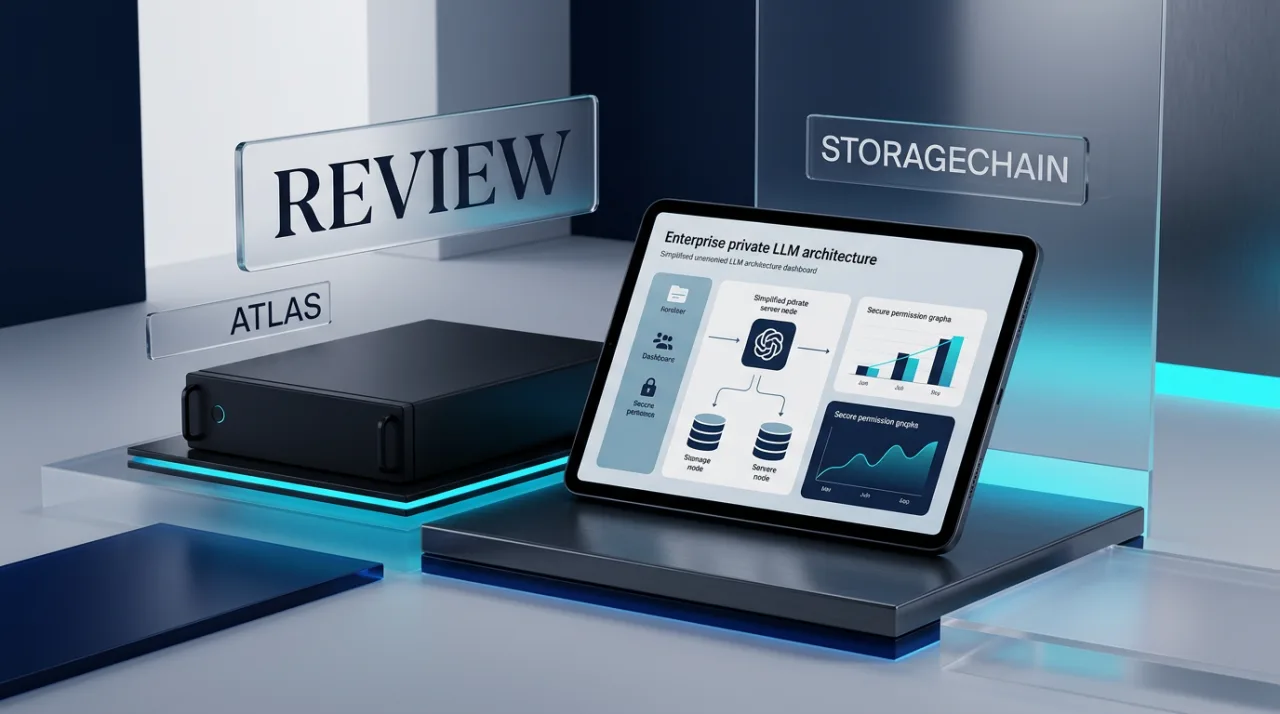
StorageChain Atlas launched on October 22, 2026, as a proprietary large language model built specifically for organizations that need to query internal documents without routing data through external providers. Developed by StorageChain LLC in Los Angeles, the model connects directly to the existing StorageChain AI Connect platform and supports both hosted and self-hosted deployments.
The service targets document-intensive sectors such as legal, healthcare, finance, logistics, and government. It preserves existing folder, user, and group permissions during indexing and avoids data duplication or migration.
StorageChain Atlas Core Capabilities and Deployment Options
Atlas functions as an on-premise or cloud-hosted LLM option that works alongside external models through approved plugins such as the ChatGPT integration. Its Permission-Aware AI architecture indexes data at the source across Microsoft SharePoint, OneDrive, Azure, Amazon S3, Google Drive, Google Cloud Storage, Dropbox, Slack, and the company’s IPFS-based decentralized storage. Semantic and vector search replace keyword matching, allowing natural-language questions over distributed collections while respecting original access controls.
Deployment flexibility includes cross-cloud connectivity and BYOC support added earlier in 2026. The platform completed a CASA Level 1 security assessment based on OWASP ASVS in August 2026 and holds Google OAuth verification. Data stays under full customer control with no transfer to third-party AI providers. Early customer examples include Rohde & Liesenfeld, which uses the system for logistics document queries.
Technical requirements center on storage volume rather than compute instances. Organizations can run the model in their own environment or subscribe to StorageChain’s hosted version. No per-user seats or per-token charges apply, and searches remain unlimited once data is indexed.
StorageChain Pricing Structure and Competitor Comparison
Pricing follows a storage-based model at $0.30 to $0.60 per GB indexed per month, listed on AWS Marketplace and company announcements. This covers the AI Connect intelligence layer with no long-term commitments or additional embedding fees. The approach claims 30 to 100 times lower cost than major providers that combine separate storage, compute, and token charges.

Compared with typical external LLM pipelines, Atlas eliminates per-token fees and per-seat subscriptions. The following table shows key differences with representative alternatives:
| Service | Pricing Basis | Data Control | Indexing Cost Range |
|---|---|---|---|
| StorageChain Atlas | Storage volume | Full customer control | $0.30–$0.60 per GB/month |
| OpenAI Enterprise | Tokens + storage | Data sent externally | Variable, often higher |
| Google Vertex AI | Tokens + compute | Data sent externally | Variable, often higher |
| Microsoft Azure OpenAI | Tokens + storage | Data sent externally | Variable, often higher |
Independent user reviews remain limited because the product reached general availability only in late October 2026. Company announcements highlight cost savings and permission preservation, while public demos on YouTube show natural-language queries across document sets. No widespread complaints about performance or billing have surfaced in available sources as of October 30, 2026.
StorageChain Atlas Limitations and Current Assessment
Atlas currently lacks published third-party benchmarks or independent accuracy tests. Roadmap details for agentic workflows remain unspecified beyond general statements about future privacy-preserving AI adoption. The pricing model requires accurate estimation of indexed data volume, which may shift for organizations with rapidly changing document stores.
Technical constraints include dependence on supported connectors for new data sources and the need for sufficient local or hosted resources when running self-hosted instances. No evidence of data breaches or compliance failures has been reported, yet the absence of long-term operational history leaves questions about sustained performance under heavy enterprise loads unanswered in public materials.
Frequently asked questions
What is StorageChain Atlas pricing based on?
StorageChain Atlas uses storage-volume pricing at $0.30 to $0.60 per GB indexed per month. The model charges nothing per user or per token and includes unlimited searches after indexing.
Does StorageChain Atlas send data to external AI providers?
No. Atlas keeps data under full customer control and supports self-hosted or permission-aware deployments that never transmit content to OpenAI, Google, or Microsoft.
Which data sources does StorageChain Atlas index?
The platform indexes Microsoft SharePoint, OneDrive, Azure, Amazon S3, Google Drive, Google Cloud Storage, Dropbox, Slack, and StorageChain’s IPFS-based storage while preserving existing permissions.
When was StorageChain Atlas released?
StorageChain Atlas launched on October 22, 2026. The parent company completed a CASA Level 1 security assessment for the underlying platform in August 2026.
Filed under
Comments 4