Reviews Crypto Exchange
OKX Proof of Reserves Review: On-Chain Assets, Verification Process and Transparency Features
At a glance
OKX has issued 48 monthly PoR reports since 2022, showing over $29 billion in primary assets with 100% or higher reserve ratios across major cryptocurrencies.
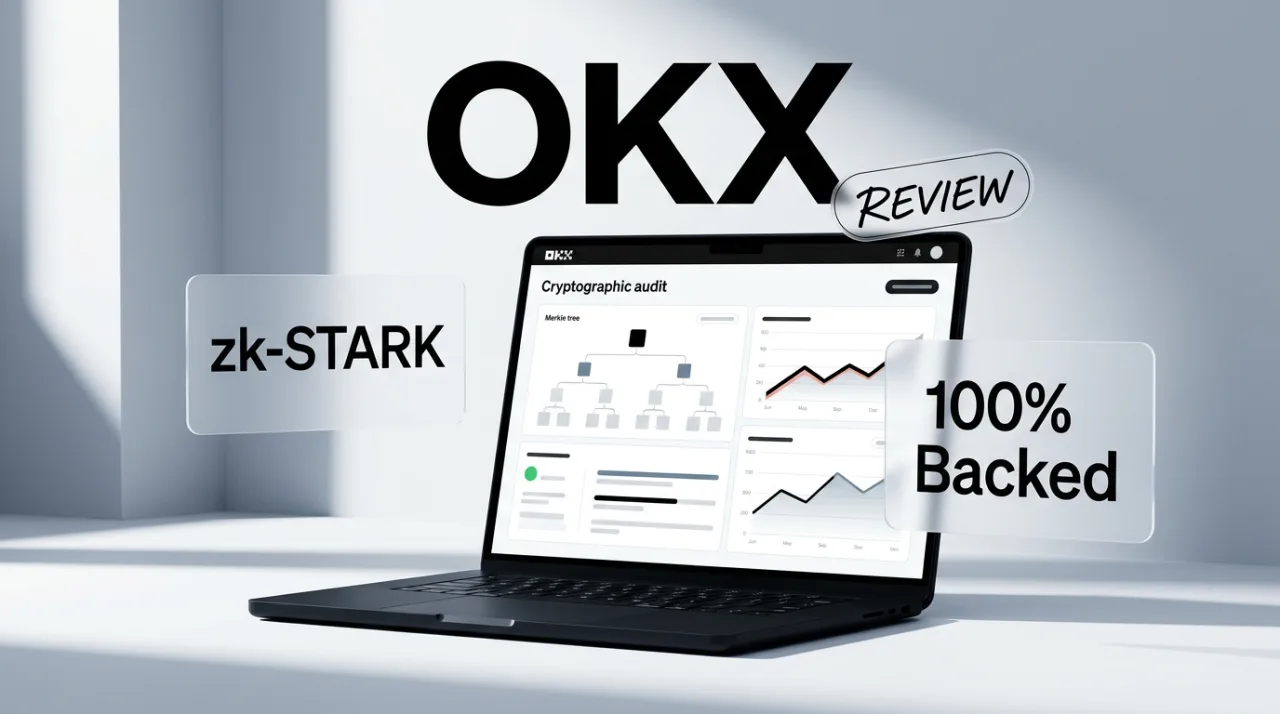
OKX launched its proof of reserves program in November 2022. The exchange has released 48 consecutive monthly reports through October 2026. The latest snapshot from early October lists $29.4 billion in primary assets and $36.36 billion across 22 cryptocurrencies held on-chain.
OKX Proof of Reserves Overview and Key Features
The program uses a zk-STARK zero-knowledge proof system built on an encrypted Merkle sum tree. This setup enforces three constraints: total balances sum correctly, individual balances stay non-negative, and every user account appears in the tree. No trusted setup is required.

Reserve ratios exceed 100 percent for covered assets. Bitcoin stands at 110 percent with 142,809 customer BTC matched against 156,475 exchange-controlled BTC. Ethereum holds exactly 100 percent, USDT reaches 105 percent, and USDC sits at 101 percent. Similar figures apply to XRP, SOL, DOGE, and OKB.
Wallet addresses appear publicly with signed messages confirming ownership. Third-party custody portions receive separate notation. Users access self-verification through the official PoR page by entering their UID to retrieve a Merkle path. Open-source tools on GitHub allow independent checks of the zk-STARK proof and address balances.
Verification Process, Limitations, and Comparisons
Reports remain point-in-time snapshots. They confirm reserves on a single date but do not address ongoing solvency or off-chain liabilities. Recent reports rely on the cryptographic system without naming an external auditor for the 48th edition, unlike earlier ones that referenced firms such as Hacken.
OKX introduced the Shield reimbursement program in October 2026 for eligible users in the US and Europe. The plan covers up to $500,000 for unauthorized third-party takeovers at no extra cost, though terms apply.
| Asset | Reserve Ratio | Customer Holdings | OKX Holdings |
|---|---|---|---|
| BTC | 110% | 142,809 | 156,475 |
| ETH | 100% | Not specified | Matches |
| USDT | 105% | Not specified | Matches |
| USDC | 101% | Not specified | Matches |
Compared with other major platforms, OKX discloses signed wallet addresses and supplies open-source validators. Some competitors publish similar Merkle-tree proofs yet omit third-party custody breakdowns or limit self-verification to mobile apps only. OKX data updates monthly without interruption since launch, a cadence matched by few exchanges.
Common user feedback on public forums notes the convenience of UID-based checks and the visibility of on-chain holdings. Complaints center on the snapshot nature of reports and the absence of real-time updates. No widespread reports of failed verifications appear in the 48 published cycles.
The 49th report is expected in late November 2026. The program continues to pair cryptographic verification with public address disclosure to support independent audits.
Frequently asked questions
How often does OKX publish proof of reserves reports?
OKX has released one report each month since November 2022, reaching 48 consecutive publications by October 2026.
What verification method does OKX use for its PoR?
The system relies on zk-STARK proofs over a Merkle sum tree with public wallet addresses and open-source validator tools for user checks.
Are OKX reserve ratios always above 100 percent?
Every asset covered in the October 2026 snapshot meets or exceeds 100 percent, with BTC at 110 percent and several stablecoins above 100 percent.
Does the OKX PoR report guarantee continuous solvency?
Reports capture balances on a single date and do not cover off-chain liabilities or provide real-time guarantees.
Filed under
Comments
No comments yet. Be the first!