Reviews Storage
Seagate Mozaic Review: HAMR SMR Drives, Azure Qualification and High-Capacity AI Storage Scaling
At a glance
Seagate Mozaic HAMR drives reached 30 TB commercial models in 2025 with SMR variants up to 36 TB, qualified by Microsoft Azure for hyperscale deployments.
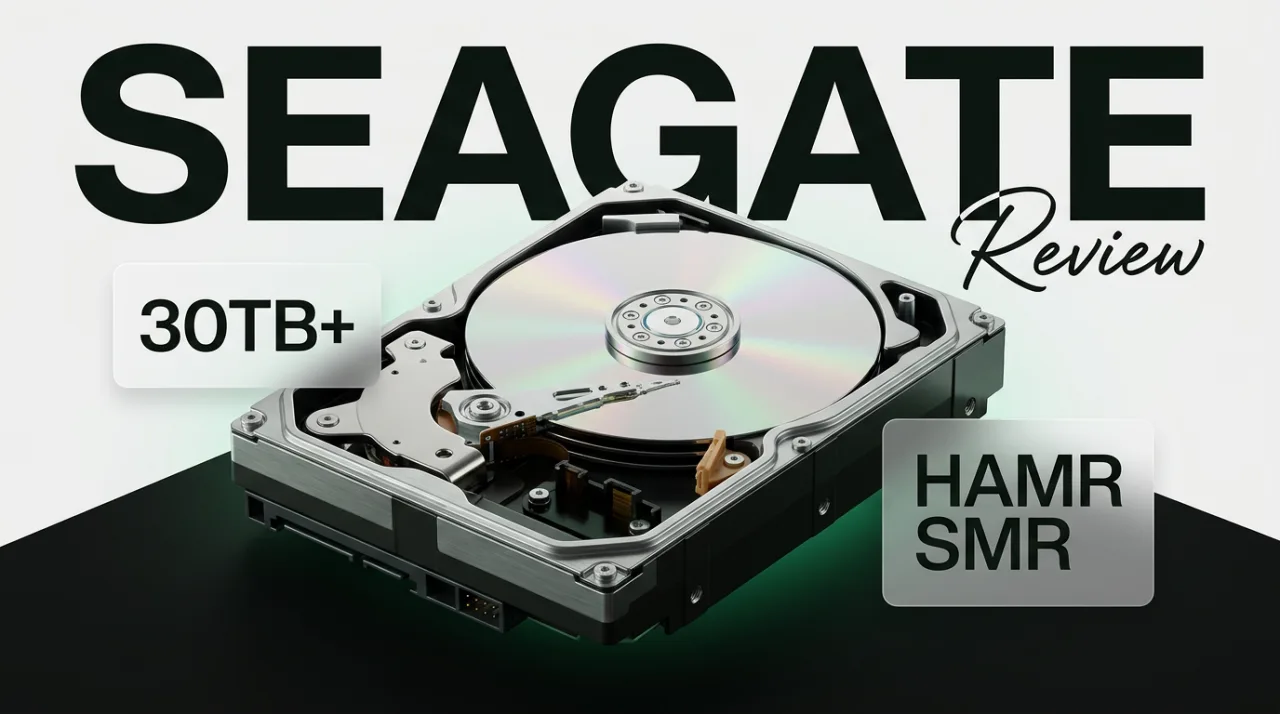
Seagate Mozaic review examines the HAMR platform that delivers higher areal density through laser-assisted writing on iron-platinum media. The Mozaic 3+ generation entered volume production in mid-2025 with 30 TB CMR models and SMR variants reaching 36 TB. These drives target AI and cloud storage fleets that need more capacity at comparable power and cost per terabyte.
Seagate Mozaic Review: Specifications, Performance and Azure Integration
The Mozaic 3+ platform uses ten platters spinning at 7200 RPM with 512 MB cache and SATA 6 Gb/s interface. Rated sustained throughput sits near 275 MB/s, while independent tests from 2025 recorded sequential reads and writes between 290 MB/s and 300 MB/s. Random 4K IOPS trail some earlier non-HAMR drives in mixed workloads, yet sequential performance remains competitive for the capacity class. Idle and write power draw exceed figures for lower-capacity models, though acoustic output stays moderate under typical loads.
Microsoft Azure Storage completed qualification of Broadcom eHBA 9600 series controllers paired with specific Seagate HAMR SMR models in late October 2026. The approved configurations include the 32 TB ST32000NM001F with firmware SR05 and the 36 TB ST36000NM001M with firmware SR01, validated on 9620-16i, 9600-24i and 9600-16i adapters at MR8.17 firmware. This pairing supplies hyperscale proof that higher-density SMR media can integrate into existing RAID ecosystems without new controller hardware.
Workload ratings list 550 TB per year with a 2.5 million hour MTBF and 0.35 percent annual failure rate. Warranty coverage runs five years. These parameters align with nearline requirements where sequential writes dominate and random access remains secondary.
Capacity Roadmap, Reliability Metrics and Competitor Context
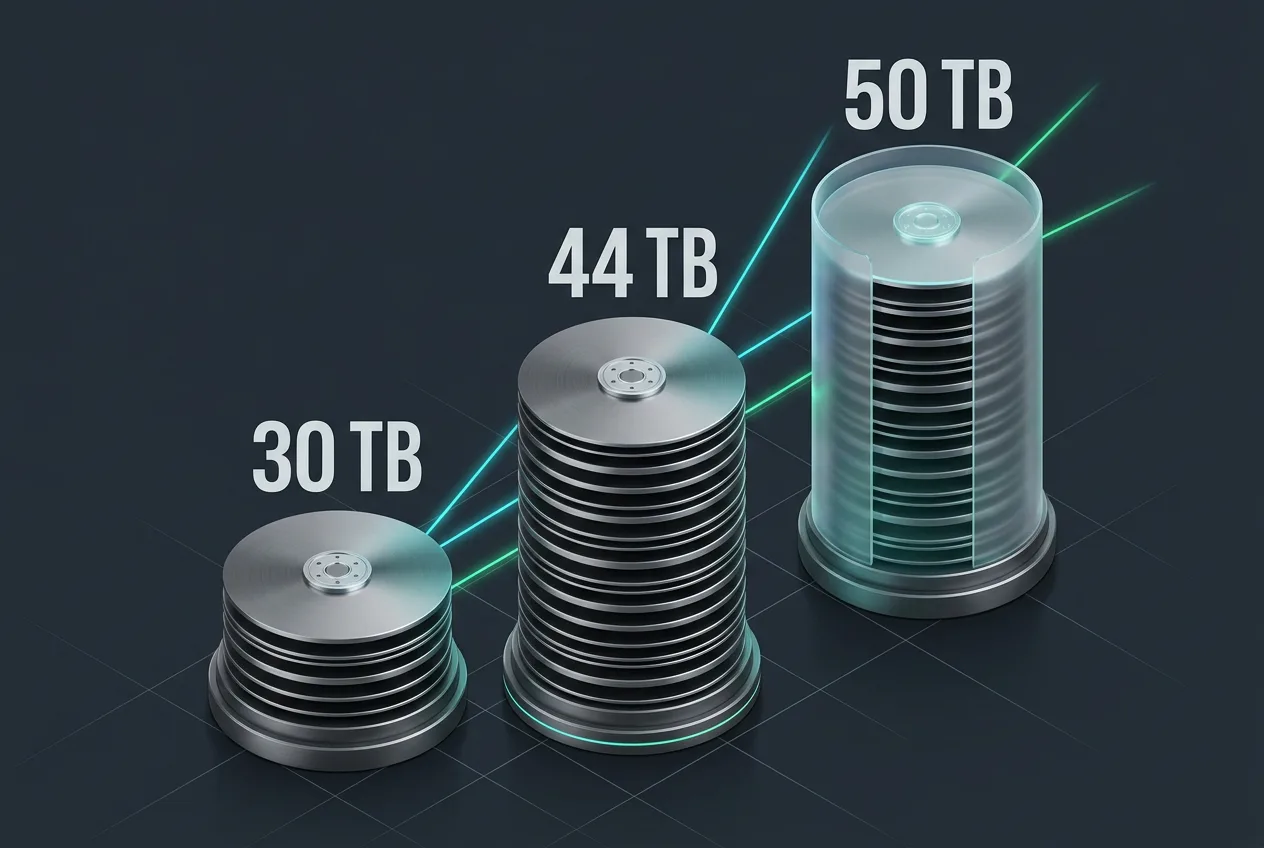
Seagate reports that Mozaic 4+ drives at 4+ TB per platter reached 44 TB capacity and entered qualification at two unnamed hyperscalers during 2026. Volume shipments began that year. Mozaic 5+ targets qualification shipments in late 2027 at roughly 50 TB, while laboratory demonstrations continue toward 10 TB per platter and 100 TB drives. Nearline supply agreements extend through 2028, with some contracts reaching 2030.
Seagate fiscal first quarter 2027 results, ended around September 2026, showed record revenue of 4.23 billion dollars, a 61 percent year-over-year increase. Nearline drives accounted for 198 of the 220 exabytes shipped, and HAMR technology represented 40 percent of the nearline exabyte run rate, on track for 50 percent by the end of calendar 2026. Mozaic 4+ contributed roughly half of that HAMR volume.
| Model | Capacity | Technology | Sustained Throughput | Workload |
|---|---|---|---|---|
| Seagate Exos M 30 TB | 30 TB | HAMR CMR | 275 MB/s rated | 550 TB/yr |
| Seagate Exos M 36 TB | 36 TB | HAMR SMR | 275 MB/s rated | 550 TB/yr |
| Typical prior-gen 20 TB | 20 TB | PMR CMR | 250 MB/s rated | 550 TB/yr |
Compared with prior perpendicular magnetic recording drives at 20 TB, the Mozaic models increase capacity by 50 to 80 percent within the same 3.5-inch form factor. Power per terabyte declines, and embodied carbon per terabyte falls because fewer drives and enclosures handle equivalent storage. SMR variants further raise density but require workloads tolerant of sequential write patterns, a constraint already accepted in many Azure and hyperscale tiers.
Limitations, Known Issues and Final Assessment
Random IOPS remain lower than some non-HAMR peers in certain database or virtual-machine workloads, limiting suitability for latency-sensitive applications. Higher power draw during writes increases thermal load inside dense racks. Supply remains largely allocated to large cloud providers, leaving smaller buyers with longer lead times through 2028. No public data yet exists on long-term field failure rates beyond the stated 0.35 percent AFR projection.
Seagate Mozaic review data confirm that HAMR has moved from two decades of research into production at scale. The combination of 30 TB CMR and 36 TB SMR models, Broadcom eHBA qualification and Azure deployment provides measurable evidence of interoperability. Continued Mozaic 4+ and 5+ ramps will determine whether the platform sustains the required density gains for AI training and inference storage fleets through the end of the decade.
Frequently asked questions
What capacities does the Seagate Mozaic 3+ platform offer?
Commercial models reached 30 TB in CMR configuration and 36 TB in SMR configuration during 2025 and 2026. Mozaic 4+ at 44 TB entered volume shipments in 2026.
Which controllers received qualification for Seagate HAMR SMR drives?
Broadcom eHBA 9600 series adapters, specifically the 9620-16i, 9600-24i and 9600-16i models, passed qualification with 32 TB and 36 TB Seagate drives in October 2026.
How does Seagate Mozaic power consumption compare with earlier drives?
Idle and write power figures exceed those of smaller-capacity drives, yet power per terabyte declines because each unit stores more data.
When will Mozaic 5+ drives ship?
Qualification shipments are scheduled for late 2027, with production volumes expected afterward.
Filed under
Comments 2