Reviews AI Models
Mistral Large 4 Review: Open-Weight 1T-Parameter MoE Model, API Access and Cybersecurity Capabilities
At a glance
Mistral Large 4 is a 1T-parameter multimodal MoE model with open weights, strong cybersecurity benchmarks and API access at roughly $0.68 per million input tokens.
Mistral Large 4 delivers a 1.05-trillion-parameter multimodal Mixture-of-Experts model from Mistral AI, released with open weights on October 29, 2026. The model handles text and image inputs, supports 160 languages and posts competitive results on cybersecurity tasks. Its open weights and API availability allow both self-hosted and cloud deployments.
Mistral Large 4 architecture, release timeline and pricing
The model contains roughly 1.05 trillion total parameters with 49 to 52 billion active per token and a separate 1.6-billion-parameter vision encoder. It was trained from scratch on about 3,800 NVIDIA Grace Blackwell GPUs in European data centers. Mistral lists a 1-million-token context window, although independent trackers measured 512K to 524K during the preview phase.
Public API access opened October 6, 2026 under the model ID mistral-large-4. Open weights followed on October 29 in FP8 and NVFP4 formats after additional reinforcement learning. The standard list price stands at $1.36 per million input tokens and $4.18 per million output tokens, with cached inputs at $0.14. A launch promotion cut these rates in half to approximately $0.68 and $2.09, with batch processing available at a further 50 percent discount.
The Mistral Ecosystem Open-Weight License permits broad use, modification and redistribution. Running the model as a hosted service for third parties requires a separate commercial license. Regional EU and US endpoints carry premium pricing through Mistral and selected third-party providers.
Cybersecurity performance, ease of deployment and comparisons
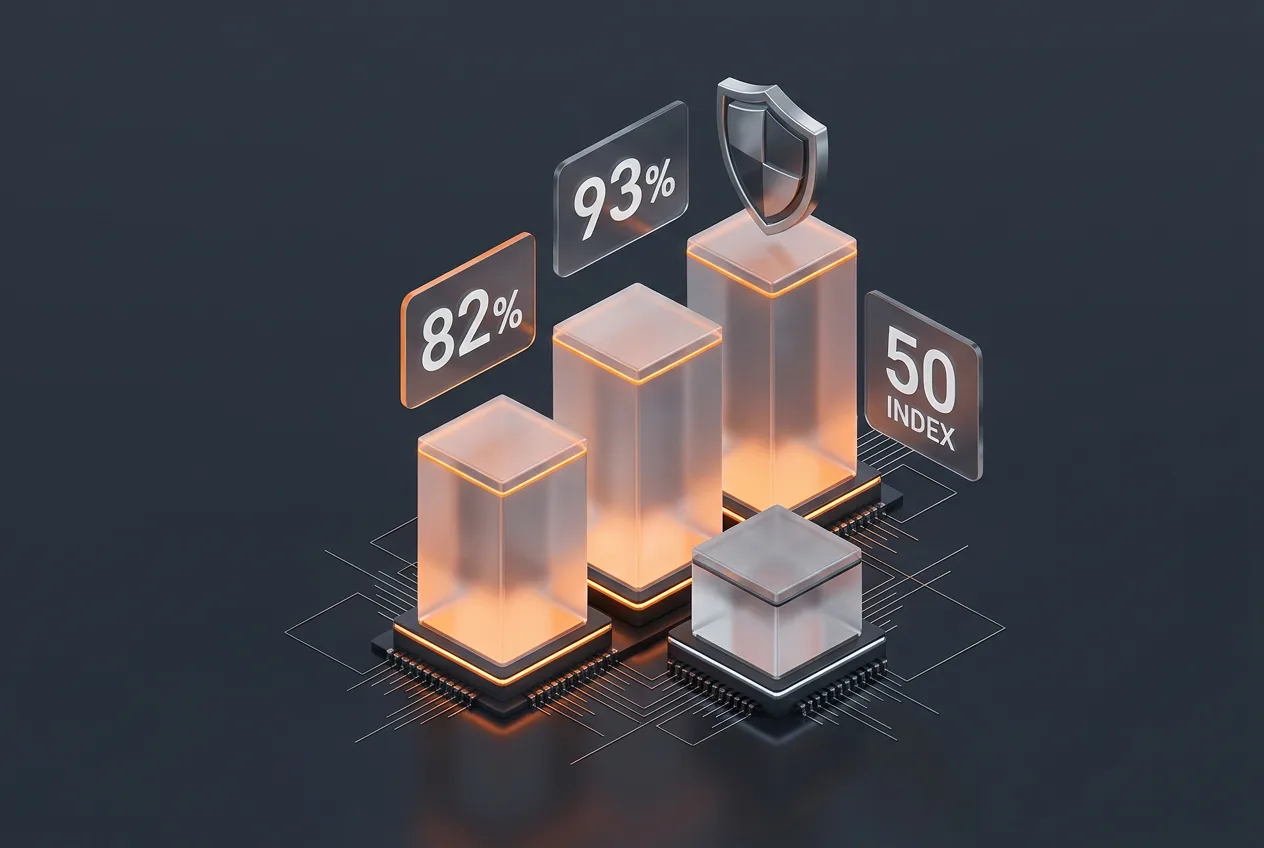
Mistral Large 4 records an Artificial Analysis Cyber Index score near 50, the highest among non-Chinese open models at launch. It reaches 82 percent on the reproduce-and-patch CyberGym-E2E benchmark and 93 percent on Cybench. The model is marketed for vulnerability discovery, malware analysis, detection-rule generation and secure-code tasks. Open weights enable on-premises or air-gapped installations that reduce provider refusals common in closed models.
Registration occurs through Mistral Studio or direct API keys. The service offers both EU and US regional options. Self-hosting requires compatible hardware; smaller distilled versions are planned for laptop deployment in the coming months. The interface supports standard chat and completion endpoints plus vision inputs.
Compared with GLM-5.3 and Kimi K3.1 Pro, Mistral Large 4 trails on general intelligence indexes but leads or matches them on several security and multilingual tasks. Against closed models it offers lower inference cost once self-hosted and removes data-sovereignty concerns for European users. Terminal-Bench 4.0 scores improved from 28 percent to 41 percent after the post-preview reinforcement learning pass.
Limitations, user feedback and final assessment
Early user reports on independent forums note occasional context truncation below the advertised 1M tokens and higher latency on image-heavy prompts. Some developers report prompt-injection resistance superior to prior Mistral releases, yet no independent red-team results have been published beyond vendor statements. The license restriction on commercial hosting remains the main operational constraint for resellers.
Pros include strong cybersecurity benchmarks, flexible open-weight licensing for on-prem use and competitive API rates during the launch window. Cons center on mid-pack general performance versus leading Chinese open models, variable context-window measurements and the extra commercial license needed for hosted services.
Independent evaluations continue to appear on Artificial Analysis and Hugging Face leaderboards. Real-world agent and cybersecurity deployments will clarify whether the October 2026 improvements hold at scale. The combination of 1T-scale open weights and targeted security capabilities positions Mistral Large 4 as a distinct option for enterprises prioritizing data control and regulatory compliance.
Frequently asked questions
When were Mistral Large 4 weights released?
Open weights became available on Hugging Face on October 29, 2026 in FP8 and NVFP4 formats after three weeks of additional training.
What is the current Mistral Large 4 API price?
List rates are $1.36 input and $4.18 output per million tokens. A launch promotion halves these to roughly $0.68 and $2.09 with no announced end date.
Does Mistral Large 4 support on-premise deployment?
Yes. The open weights and modified MIT-style license allow self-hosting, including air-gapped environments, subject to the commercial hosting restriction.
How does Mistral Large 4 perform on security benchmarks?
It scores approximately 50 on the Artificial Analysis Cyber Index and reaches 82 percent on CyberGym-E2E and 93 percent on Cybench, leading non-Chinese open models.
Filed under
Comments 5