Reviews Mistral AI
Mistral Large 3 Review: Pricing and Limits Explained
At a glance
Mistral Large 3 review details the 675B MoE model's API pricing at $0.50 per million input tokens, 256K context limits, and tiered rate controls.
Mistral Large 3 review starts with the model released on December 2, 2025. The flagship open-weight multimodal MoE model carries 675B total parameters with 41B active parameters. It accepts text and image inputs while returning text outputs under an Apache 2.0 license.
Developers access it through the Mistral AI API, AWS Bedrock, Azure, and Hugging Face. The model supports function calling, structured JSON outputs, streaming, document question answering, and agent conversations. Training ran on roughly 3,000 H200 GPUs, positioning it as a cost-efficient option that matches leading models on general tasks.
Mistral Large 3 Review: API Pricing, Context Window and Rate Limits
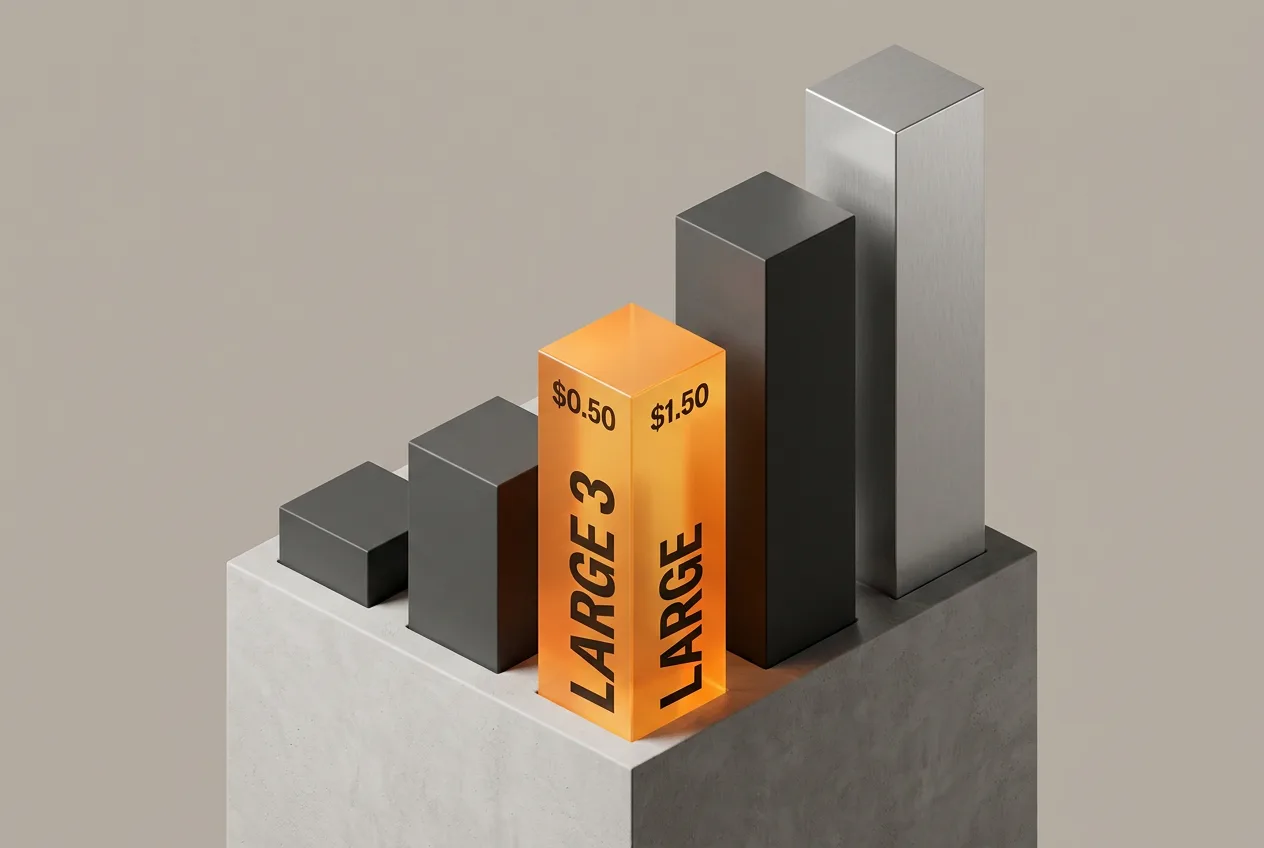
Pricing on the Mistral AI API stands at $0.50 per million input tokens, $0.05 for cached input tokens, and $1.50 per million output tokens. The Batch API delivers approximately 50 percent discounts. Hosted versions on AWS Bedrock and Azure maintain comparable rates. Token counts cover both input and output combined.
The context window reaches 256K tokens. Requests that exceed this limit return a 400 error. Maximum output tokens depend on the provider and can reach 256K on some platforms or lower on others. Rate limits operate at the organization level and differ by plan. The free evaluation tier imposes the strictest caps, while pay-as-you-go tiers scale with spend. Limits cover requests per second and tokens per minute separately. Batch jobs avoid real-time restrictions. Users check current values in the Admin Panel or through response headers such as X-RateLimit-Remaining.
Exact RPM and TPM numbers are not fixed publicly and appear only in the console. Enterprise accounts can request a Priority Tier or custom limits through support. No major pricing changes have been announced as of October 2026.
Mistral AI Models Comparison, Pros, Cons and Known Limitations
Within the Mistral 3 family, Large 3 sits as the value flagship. Mistral Large 4 lists at roughly $1.36 input and $4.18 output. Medium 3.5 runs $1.50 input and $7.50 output. Small 4 costs $0.15 input and $0.60 output. Ministral 3 variants fall between $0.10 and $0.20 symmetric pricing. Large 3 therefore offers the strongest balance of capability and cost for high-volume workloads.
Advantages include the 256K context window, strong multilingual and image understanding, Apache 2.0 licensing, and broad platform availability. Drawbacks center on variable rate limits that require console checks, provider-specific output caps, and the absence of fixed public RPM or TPM tables. Requests over the context window fail immediately, and organizations on the free tier often hit limits quickly during testing.
User reports on public forums note occasional throttling during peak hours on the free tier and the need to monitor spend for tier upgrades. No widespread complaints about billing accuracy or data handling appear in recent discussions. The model remains positioned for production use where predictable token costs and large context matter more than the lowest possible rates.
Frequently asked questions
What is the exact input and output price for Mistral Large 3?
The Mistral AI API charges $0.50 per million input tokens and $1.50 per million output tokens. Cached input tokens cost $0.05 per million. Batch API usage receives a 50 percent discount on these rates.
How large is the context window and what happens when it is exceeded?
Mistral Large 3 supports a 256K token context window. Any request that surpasses this limit returns a 400 error. Token counts include both prompt and completion tokens.
Are rate limits fixed or do they change by plan?
Rate limits are organization-level and scale with plan tier and spend. Free accounts receive the lowest RPS and TPM values. Pay-as-you-go and Priority Tier users see higher caps visible in the Admin Panel and response headers.
How does Mistral Large 3 pricing compare with other Mistral models?
Large 3 costs less than Large 4 and Medium 3.5 while delivering higher capability than Small 4 or Ministral 3 variants. It provides the lowest cost per token among the high-performance options in the current lineup.
Filed under
Comments
No comments yet. Be the first!