Reviews VPN
First VPN Review: Sanctions History, Features and Security Risks
At a glance
First VPN operated from 2014 until its 2026 dismantling in Operation Saffron. This review details its claimed features, sanctions and documented security failures.
First VPN, also known as 1VPNS, operated from approximately 2014 until law enforcement dismantled its infrastructure in May 2026. It positioned itself as a no-logs service accepting cryptocurrency payments and marketed heavily on Russian-language cybercrime forums for evading detection.
The service offered 32 exit nodes across 27 countries, including three in the United States. Supported protocols included OpenConnect, WireGuard, Outline and VLESS TCP Reality. Encryption options ranged from OpenVPN ECC to L2TP/IPSec and PPTP. Subscriptions started at two dollars per day and reached 483 dollars annually.
First VPN Features and Claims
Administrators promoted multi-node routing, self-hosted Jabber support and firewall configuration tools. The service claimed proprietary DNS servers and explicit refusal to cooperate with authorities. It provided access to onion domains alongside clearnet addresses at 1vpns.com, 1vpns.net and 1vpns.org.
Users could select specific exit nodes for added routing control. Payment methods included Bitcoin and Perfect Money. The platform did not publish independent security audits or transparency reports during its operation.
Registration required minimal information, aligning with its anonymity-focused marketing. Technical support operated through Telegram and Jabber channels. No public evidence emerged of routine logging practices until the 2026 seizure of user databases.
Sanctions, Takedown and Security Implications
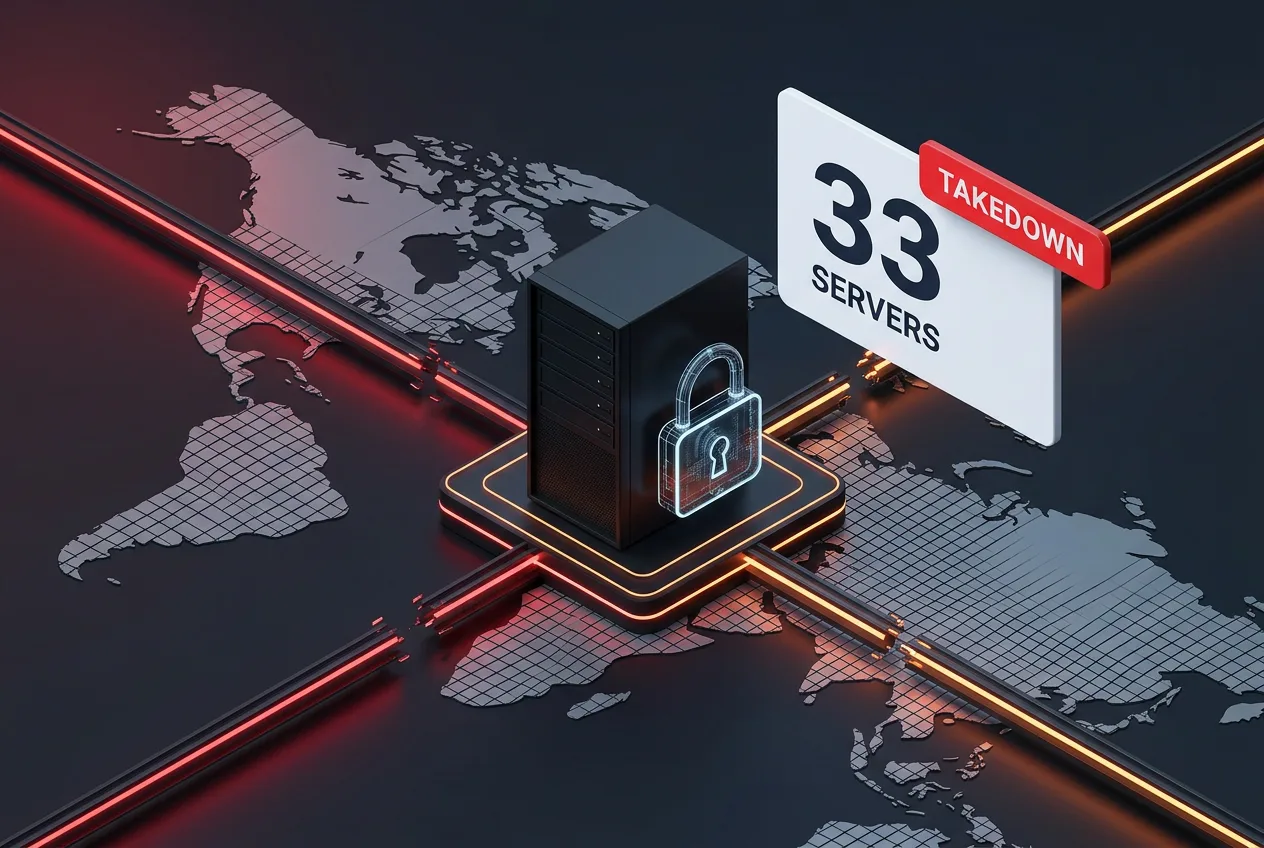
Europol coordinated Operation Saffron on May 19-20, 2026, resulting in the seizure of 33 servers across 27 countries. French and Dutch authorities led the effort with participation from 16 to 18 nations. Domains, the Jabber server and associated infrastructure were taken offline. Ukrainian national Dmytro Rashevskyi, identified as the administrator, was questioned in Dnipro.
The U.S. Treasury sanctioned First VPN Service and Rashevskyi on July 13, 2026, under Executive Order 13694. This marked the first sanctions action against a VPN provider. The service appeared in nearly every major Europol cybercrime investigation and linked to at least 25 ransomware groups.
| Service | Audit Status | Legal Cooperation | Current Status |
|---|---|---|---|
| First VPN | None published | Claimed refusal | Dismantled 2026 |
| Proton VPN | Multiple independent | Complies with valid requests | Active |
| Mullvad | Regular third-party | Limited data retention | Active |
| Surfshark | Annual independent | Complies with warrants | Active |
Authorities obtained the user database during the raid. Data from 506 high-value accounts was shared across 83 intelligence packages. Reddit discussions from 2026 highlight that the service targeted criminal users and that its no-logs claims proved unreliable after infiltration.
Legitimate users risked identification because the service maintained no verified audit trail. Sanctions remain active as of November 2026, creating potential legal exposure for any continued transactions with sanctioned entities.
Frequently asked questions
What happened to First VPN in 2026?
Law enforcement seized its servers in May 2026 during Operation Saffron. The administrator was questioned and the service domains were taken down.
Did First VPN keep logs?
It claimed a no-logs policy. Authorities obtained user databases after the takedown, contradicting the marketing claims.
Is First VPN still operating?
No. Infrastructure was dismantled in May 2026 and sanctions were imposed in July 2026.
What alternatives exist to First VPN?
Audited services such as Proton VPN, Mullvad and Surfshark publish independent reports and maintain clearer legal compliance policies.
Are there risks from using sanctioned VPNs?
U.S. persons face prohibitions on transactions with sanctioned entities. Data exposure occurred for former First VPN users after the seizure.
Filed under
Comments 1