Reviews Fhenix
Fhenix Review: CoFHE Coprocessor Features, Dual-Mode Tokens and Mainnet Details
At a glance
Fhenix CoFHE enables confidential computations on EVM chains through off-chain FHE processing and single-contract dual-mode tokens.
Fhenix review centers on its CoFHE coprocessor, which brings fully homomorphic encryption to any EVM-compatible chain without requiring migration or new languages. Launched on Ethereum and Arbitrum mainnets on October 21, 2026, the system runs heavy FHE operations off-chain while contracts continue to use standard Solidity after one import. Developers gain encrypted data types that function like ordinary variables.
Fhenix CoFHE Overview, Features and Mainnet Deployment
The coprocessor targets confidential smart-contract logic on public blockchains. Contracts import a single library and declare variables such as euint64; the Fhenix network handles encrypted arithmetic in a scalable off-chain pipeline and returns results with ZK proofs and on-chain commitments. Threshold MPC distributes decryption keys across independent parties that reassemble them only inside attested TEE enclaves.
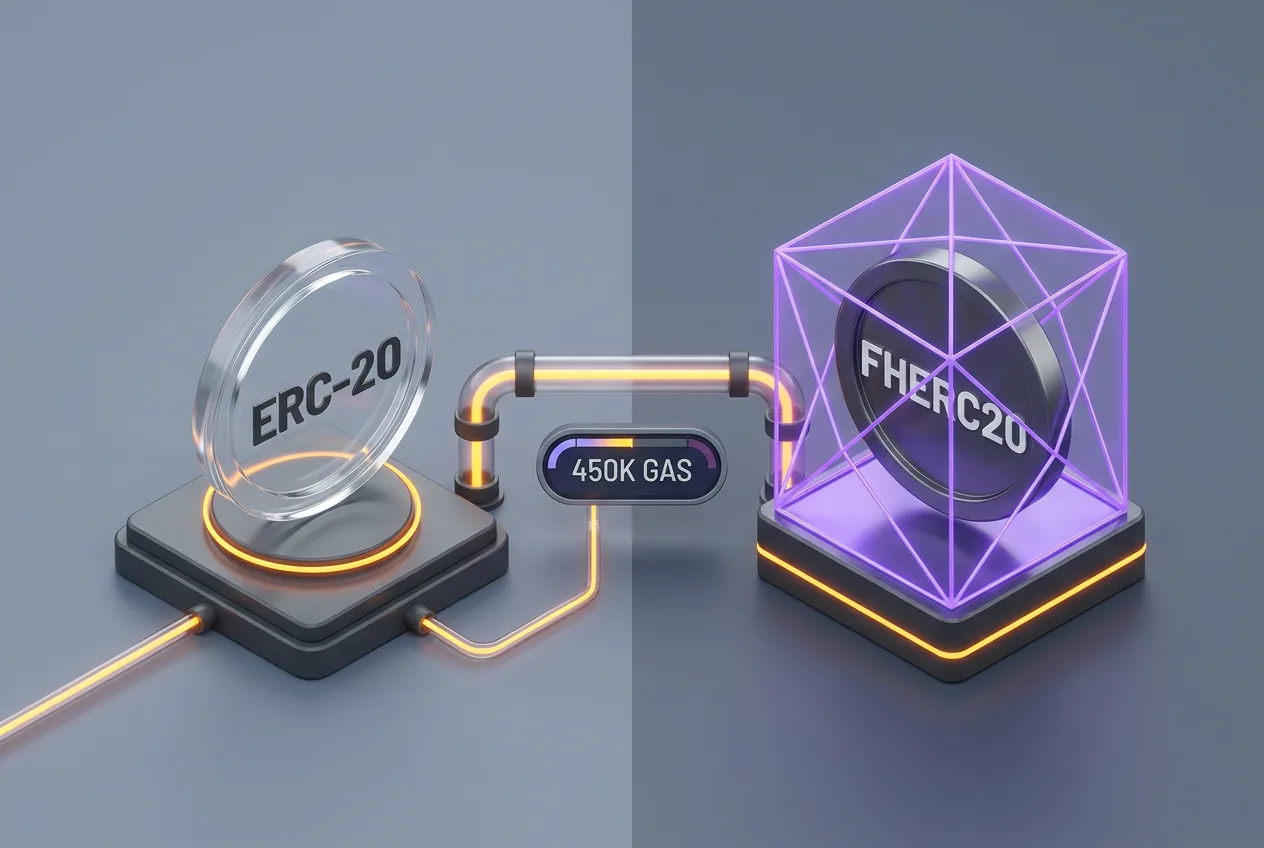
Key capabilities include confidential token balances, private contract state, sealed inputs for bids or votes, and selective decryption controlled by access-control permits. Dual-mode tokens follow the FHERC20 standard: one contract address holds both a visible ERC-20 balance and an encrypted balance. Holders switch modes in a single transaction, preserving compatibility with existing wallets and exchanges while keeping amounts hidden. Metadata such as sender, recipient and timing remains visible for compliance.
Mainnet access currently requires Fhenix team review and allowlisting. Testnets on Ethereum Sepolia, Arbitrum Sepolia and Base Sepolia stay open. Three design-partner applications launched on day one, including Fluton for encrypted intents and AlphaEngine for private trading strategies. Additional dApps and a confidential stablecoin with Tandem are scheduled for Q4 2026.
Pricing, Security Model and Current Limitations
No separate subscription or per-computation fees for CoFHE have been published. Users pay only the host-chain gas for operation requests. Reference figures for FHERC20 confidential transfers range from 421,000 to 474,000 gas units; the actual encrypted math incurs no gas. Benchmarks from research implementations show roughly 20,000 times higher throughput and 37 times lower latency for threshold decryption compared with earlier designs.
Security relies on end-to-end encryption, ZK input proofs and attested execution environments. An audit by Consensys Diligence has been completed, though the full report is not yet publicly posted. Privacy guarantees cover amounts and balances; addresses and timestamps stay on-chain. The system evolved from earlier FHE rollup concepts to a chain-agnostic coprocessor to reach broader adoption.
Compared with standard EVM contracts, CoFHE adds encrypted state and computation at the cost of higher request gas and an allowlist step for mainnet. Relative to other privacy-focused EVM extensions, it avoids wrapping or bridging steps by keeping both public and confidential balances under one address. Public user reviews remain limited because mainnet deployment occurred only days ago; early developer feedback centers on the simplicity of the single-line import and the absence of toolchain changes. No widespread complaints about downtime or incorrect results have surfaced in available sources.
Current restrictions include the allowlist requirement for production contracts and the fact that only a small number of applications have live access. Gas costs for encrypted transfers exceed typical ERC-20 transfers, and long-term economic sustainability depends on future fee structures not yet detailed. The design keeps metadata visible, which satisfies some regulatory needs but limits full anonymity.
Frequently asked questions
What chains does Fhenix CoFHE currently support on mainnet?
CoFHE runs on Ethereum and Arbitrum mainnets since October 21, 2026, initially through an allowlist process. Identical libraries are available on the corresponding Sepolia testnets and Base Sepolia.
How do dual-mode tokens work on Fhenix?
FHERC20 tokens maintain both a standard ERC-20 balance and an encrypted balance inside one contract. Holders switch between modes in a single transaction without wrapping or separate liquidity pools.
What gas costs apply to confidential operations?
Only host-chain gas is charged for submitting FHE requests. Example confidential transfers consume 421,000 to 474,000 gas; the off-chain encrypted computation itself adds no gas.
Is Fhenix CoFHE audited?
An audit by Consensys Diligence has been performed. The full report has not been published publicly as of October 2026.
Filed under
Comments
No comments yet. Be the first!