Reviews AI Models
ERNIE 5.5 Flash Base review: 280B Model Capabilities, Context Limits and Access
At a glance
Baidu released the ERNIE-5.5-Flash-Base checkpoint in November 2026. This review examines its architecture, benchmarks, licensing restrictions and how to run it.
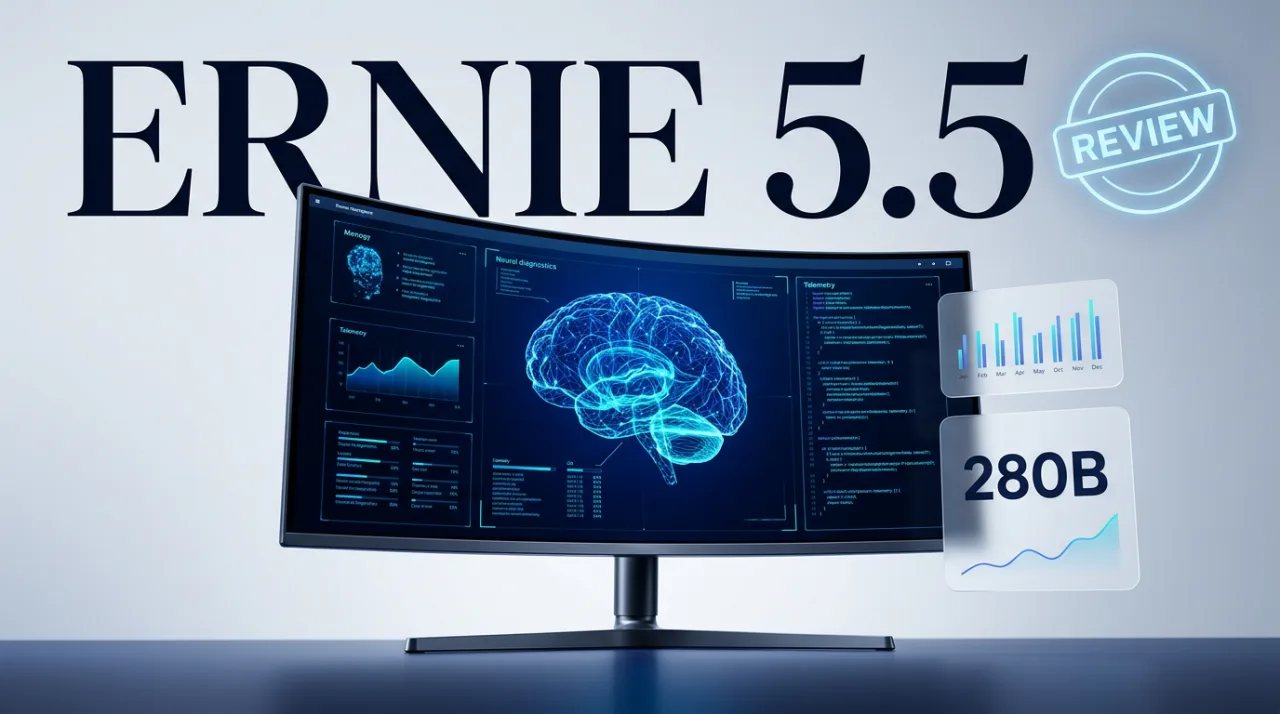
Baidu released ERNIE-5.5-Flash-Base on November 5, 2026 as a text-only sparse MoE base model. The checkpoint contains 280 billion total parameters with 14 billion activated per token. It was trained from scratch on 33.5 trillion tokens and supports inference contexts up to one million tokens through its released configuration.
The model targets researchers and developers who need an efficient foundation for further training or inference. It ships without mid-training or post-training, so users must handle alignment themselves. Weights are available in FP8 and BF16 formats on Hugging Face under the baidu organization.
ERNIE 5.5 Flash Base Overview and Features
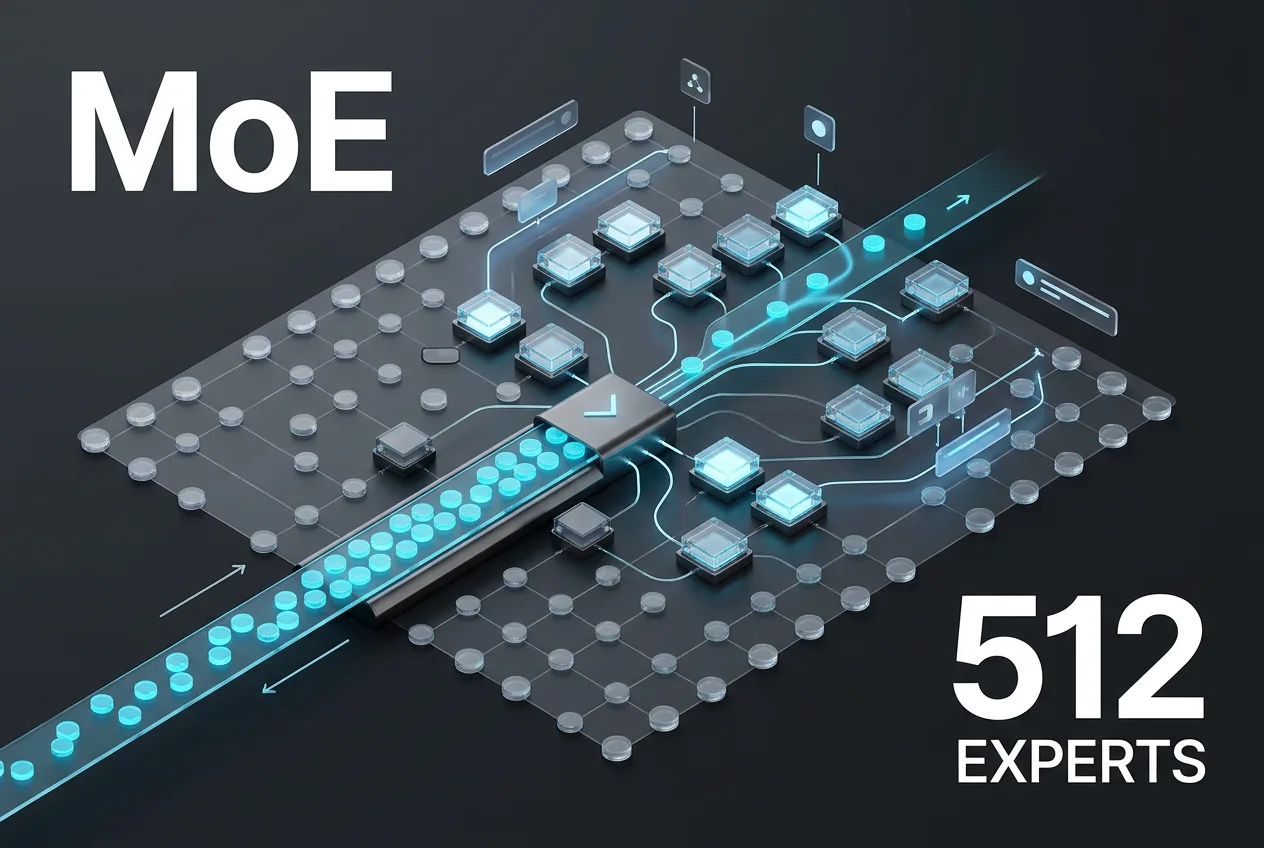
The architecture uses 43 layers with one dense layer followed by 42 MoE layers. Each MoE layer contains 512 routed experts plus one shared expert, activating the top 10 experts per token in a 2048-dimensional latent space. Hidden size is 4096. Hybrid attention combines 37 Heavily Compressed Attention layers and 6 Multi-head Latent Attention layers to reduce memory use during long-context inference.
Training used the Muon optimizer and FP8 mixed precision with a maximum context of 128K tokens. The vocabulary size is approximately 201K tokens using BPE tokenization that handles numbers right-to-left. The model includes ECHO support for speculative decoding, which improves generation speed on compatible runtimes.
Self-reported benchmark scores place the model ahead of DeepSeek-V4-Flash-Base, Hy3-preview-Base and MiMo-V2.5-Base on several standard tests. It records 93.3 on MMLU, 78.4 on MMLU-Pro, 60.2 on GPQA, 82.3 on HumanEval+ and 40.1 on LiveCodeBench. Results are mixed on long-context retrieval and certain Chinese-language tasks.
ERNIE 5.5 Flash Pricing, Access and Deployment
No hosted API or usage-based pricing exists. Users must self-host the model. Weights are downloadable from Hugging Face and ModelScope in safetensors format. Deployment works through SGLang or vLLM using the completions endpoint. The base model is not chat-tuned, so additional fine-tuning is required for conversational use.
The license permits free non-commercial and research use. Commercial use is free for products generating less than 50 million USD in annual related revenue, provided the product displays a “Powered by ERNIE” notice and sends one-time notification to Baidu. Higher revenue requires prior written authorization. The license prohibits use, distribution or output generation inside the EU, UK and South Korea. It also forbids using the weights or outputs to train or improve competing models.
Technical requirements include sufficient GPU memory for the 280B parameter footprint at FP8 or BF16 precision. Fine-tuning and inference configurations support up to 1,048,576 tokens. No official pricing tiers or hosted options have been announced, and a post-trained version is expected later.
ERNIE 5.5 Flash Base Limitations and Comparisons
The model shows clear efficiency advantages from its sparse MoE design and hybrid attention. However, the custom license creates geographic and commercial restrictions not present in fully open licenses such as Apache 2.0. Absence of a hosted API limits accessibility for teams without large-scale infrastructure.
| Model | Parameters (total/active) | Max Context | License Restrictions | Hosted API |
|---|---|---|---|---|
| ERNIE-5.5-Flash-Base | 280B / 14B | 1M | Geographic + revenue cap | No |
| DeepSeek-V4-Flash-Base | 236B / ~20B | 128K | Apache 2.0 | Yes |
| Hy3-preview-Base | 310B / 18B | 512K | Research only | No |
Common user complaints center on the geographic exclusions and the prohibition on improving other models. Positive feedback highlights strong code and reasoning scores relative to parameter activation count. No widespread reports of training instability or inference bugs have surfaced yet because the release is recent.
The checkpoint fills a niche for organizations that want a high-capacity MoE base with long-context support and are willing to manage their own post-training and infrastructure. Teams operating inside restricted regions or planning commercial products above the revenue threshold must evaluate the license terms carefully before downloading weights.
Frequently asked questions
What is the maximum context length supported by ERNIE 5.5 Flash Base?
The released configuration supports up to 1,048,576 tokens for fine-tuning and inference. Pre-training used a maximum of 128K tokens.
Is ERNIE 5.5 Flash Base available through an API?
No hosted API or pricing has been announced. Users must download weights and run the model themselves via frameworks such as vLLM or SGLang.
Can ERNIE 5.5 Flash Base be used commercially?
Commercial use is permitted without fees below 50 million USD in annual related revenue, subject to notice requirements. Higher revenue requires prior authorization from Baidu. Use is prohibited in the EU, UK and South Korea.
How does ERNIE 5.5 Flash Base compare to DeepSeek-V4-Flash-Base on benchmarks?
Self-reported scores show ERNIE 5.5 Flash Base ahead on MMLU, MMLU-Pro, GPQA and code benchmarks while trailing on some long-context retrieval tasks.
Filed under
Comments
No comments yet. Be the first!